
x
60% Faster Performance

How Holograph helped Hyundai Mobis transform its Atlassian Ecosystem


Let’s Connect

Fill up the form, we will
reach out to you.
Thank you for your interest.
Your webinar registration is confirmed.
Our team will reach out with the session details and calendar invite soon.
Oops! Something went wrong while submitting the form.

Significant Cost Savings:

$50,000+
saved on license management
$15.000
annually saved on managed services

Client Overview

Hyundai Mobis is a South Korean global leader in the automotive parts industry & a key player in the Hyundai Motor Group. Established in 1977, the company focuses on the development, manufacturing & supply of automotive components & systems. Hyundai Mobis is renowned for its innovation in automotive technology & is involved in creating cutting-edge solutions that support the growth of the automotive industry.

The company specializes in a wide range of products, including advanced vehicle safety systems, autonomous driving technologies, green mobility solutions, infotainment systems, lighting systems, & electronic modules. Hyundai Mobis is deeply committed to sustainability & environmental stewardship, striving to make significant advancements in eco-friendly automotive solutions such as electric vehicle (EV) parts and systems.

Challenges

Hyundai Mobis faced several challenges with their existing Atlassian setup, which were impacting both operational efficiency and long-term scalability. Some of the key pain points included:

Scaling the System
The existing system lacked the flexibility to scale effectively as the organization grew, hindering the ability to expand its usage across teams and regions.
A Missed Best Practices
The implementation by their previous Atlassian partner failed to adhere to best practices, resulting in a system that was not optimized for performance, scalability, or usability.
System Performance Issues
The slow performance of key tools—Jira, Confluence, Bitbucket, and Crowd—was negatively affecting user experience, as well as the ability to generate reports quickly for management. The system's sluggishness made it difficult for users to work efficiently, especially when dealing with large volumes of data.
Redundant Add-ons
Several add-ons, recommended by the previous supplier, were either unnecessary or underutilized. This led to a bloated system, creating confusion for users who were unaware of the true purpose of these add-ons. We streamlined the add-on ecosystem, removing redundant tools to improve system performance and clarity.
Lack of System Documentation
There was no documentation outlining the purpose or architecture of the existing Atlassian ecosystem. This lack of clarity made it challenging for Hyundai Mobis to understand how the system was implemented, and left them without insights into how various components were interconnected.
Cross-Platform Collaboration Issues
Cross-platform collaboration between Hyundai's Indian & Korean teams was problematic. The previous system lacked proper integration, especially for inter-team communication & synchronization. The Exalate Connector for Jira, which we implemented, was not initially configured correctly & the system was neither scalable nor maintainable. Frequent changes to the system would lead to errors, creating a sense of uncertainty & reluctance to make necessary adjustments.
Unnecessary Apache Web Server Setup
The previous system had Apache Web Server installed solely for SSL purposes, which added unnecessary complexity and overhead to the system architecture.
Inefficient Reporting
Reports took over 15 minutes to load, severely hampering decision-making and management oversight. The absence of key performance indicators (KPIs) in reports added to the difficulty in tracking progress and performance metrics effectively.

Results Powered by Holograph

The implementation delivered measurable improvements and positioned Hyundai Mobis for long-term success with their Atlassian ecosystem. Key outcomes include:

Streamlined Architecture:

The Atlassian tool ecosystem was thoroughly documented, designed, and implemented, creating a scalable and maintainable architecture.

Performance Boost:

Overall system performance improved by 60%, ensuring smoother operations and faster processing.

Enhanced Understanding:

Stakeholders, end-users, and management gained a better grasp of the Atlassian ecosystem, improving usability and fostering confidence in the system.

Reduced Dependency:

Reliance on Atlassian support engineers decreased significantly, empowering internal teams to manage the ecosystem independently.

Improved Reporting:

Productivity and efficiency in reporting surged, driving greater usability and end-user acceptance of the Atlassian ecosystem.

Future-Proofed Scalability:

The ecosystem was scaled to align with growth forecasts for the next three years, ensuring it could support Hyundai Mobis' evolving needs.

Centralized Access Management:

Implementation of SSO for all Atlassian products streamlined user management, enhancing security and simplifying access control.

Operational Stability:

The Atlassian ecosystem was stabilized, ensuring reliable performance and seamless day-to-day operations.

Implementation Process

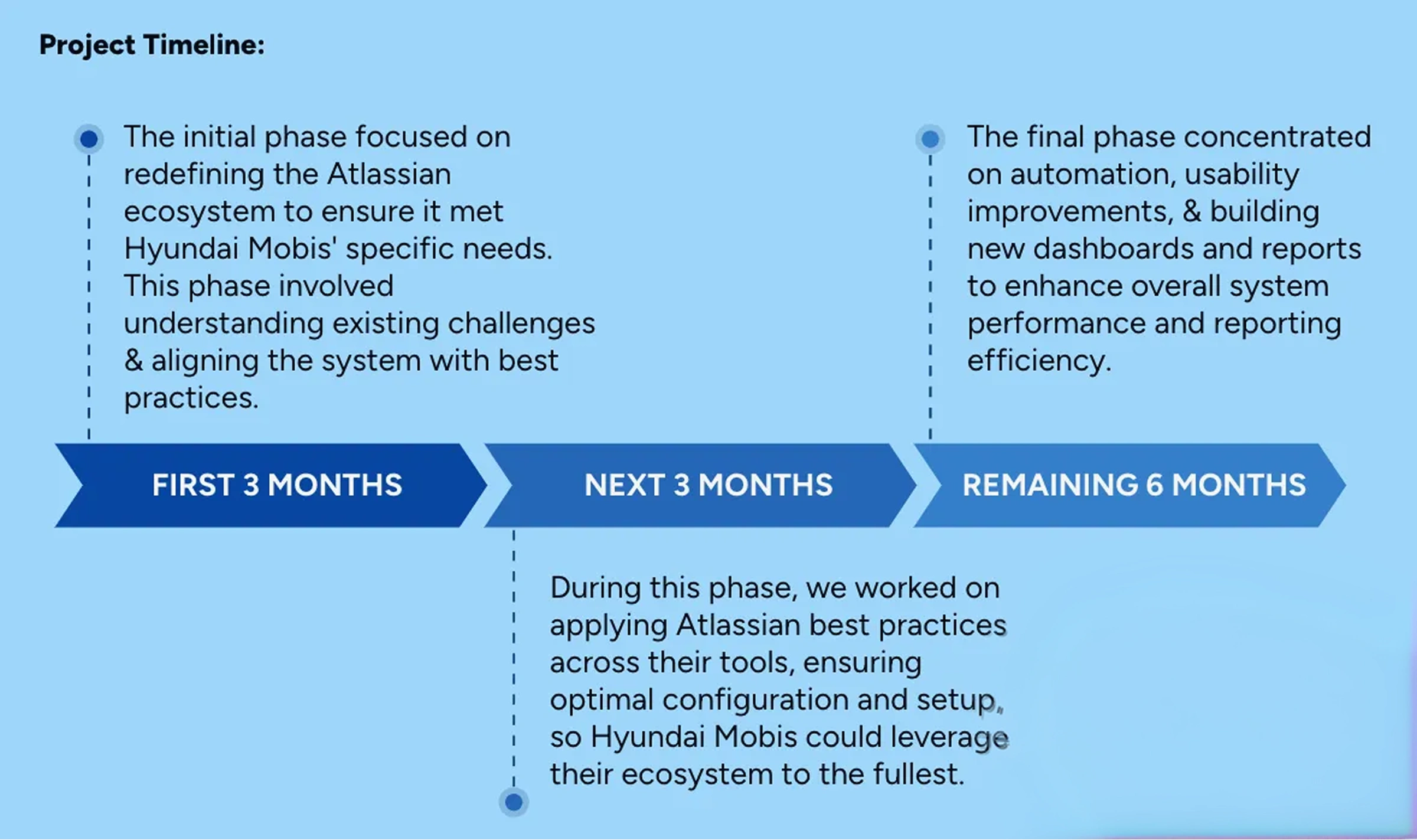
The implementation of the solution followed a well-structured process using a combination of Scrum and Kanban frameworks to ensure flexibility, efficiency, and alignment with Hyundai Mobis' evolving needs.

Framework Utilization:

We initially used the Scrum framework to refine the Atlassian ecosystem, focusing on iterating quickly and continuously improving the setup based on stakeholder feedback. After refining the ecosystem, the Kanban framework was introduced for ongoing monitoring and optimization.

Daily Standups & Weekly Stakeholder Meetings:

To maintain clear communication & rapid decision-making, we held daily standups with the internal team & weekly meetings with stakeholders. This ensured that everyone remained aligned and that any issues were quickly addressed.

Ongoing Support:

Post-implementation, Hyundai Mobis was provided with yearly support & services to ensure the continued success of the system, including any future refinements, training needs & problem resolution. This ensured they could keep scaling & adapting their Atlassian tools as required.
How Holograph helped Hyundai Mobis transform its Atlassian Ecosystem