Mastering AWS Cost Optimization for 2026: Strategies to Maximize Cloud ROI
Cloud spending continues accelerating as organizations expand AWS footprints, yet many struggle to translate that investment into proportional business value. More than 40% of organizations identify workload optimization and waste reduction as their primary focus, revealing that cost management remains a persistent challenge even for mature cloud adopters. The gap between cloud promise and reality often traces back to a fundamental issue: organizations treat cost optimization as a one-time cleanup exercise rather than an ongoing discipline.
The financial stakes justify serious attention. Research shows that organizations waste up to 47% of cloud budgets on underutilized resources, with idle infrastructure, overprovisioned components, and suboptimal commitment strategies draining value that could fund innovation initiatives. This waste compounds over time as applications proliferate and teams expand AWS usage without corresponding financial governance. The 2025 State of FinOps Report confirms that despite years of cloud adoption, cost optimization remains challenging for the vast majority of enterprises.
Strategic AWS cloud transformation requires embedding financial operations into technical decision-making from day one. Organizations that integrate FinOps practices early in their cloud journey consistently outperform those treating cost as an afterthought. This integration transforms cloud spending from unpredictable variable expense into strategic investment aligned with business objectives.
Understanding FinOps as Organizational Capability
FinOps represents more than cost monitoring tools or budget alerts. The practice establishes a cultural and operational shift that integrates financial accountability directly into cloud decisions. Rather than treating cost as an afterthought, FinOps brings financial considerations to the forefront of technical decision-making, helping teams optimize expenditure while maintaining balance between speed, quality, and business impact.
The FinOps Foundation framework, part of the Linux Foundation, provides comprehensive best practices organized around three phases: Inform, Optimize, and Operate. Organizations progress through these phases iteratively, building capability that evolves as cloud adoption matures. The framework recognizes that different teams require different approaches based on their cloud maturity, organizational structure, and business priorities.
Inform phase establishes visibility and accountability. Teams cannot optimize what they cannot see, making cost transparency the essential first step. AWS provides native tools that support this visibility. AWS Cost and Usage Report delivers granular, line-item cost and usage data that can be exported to S3 buckets for analysis. This data serves as the foundation for custom dashboards, unit economics tracking, and integration with FinOps platforms that provide deeper insights.
Amazon recently shared their internal FinOps transformation journey, revealing how they evolved from monthly cost reviews to hourly optimization actions. Their experience demonstrates that moving from account-level visibility to ARN-level granularity enables dramatically more effective optimization. When teams can attribute costs to specific resources and applications, they make informed decisions about tradeoffs between performance, availability, and spending.
Optimize phase applies insights to reduce waste and improve efficiency. This goes beyond simple cost cutting to strategic resource allocation that maximizes business value per dollar spent. Teams identify quick wins through idle resource elimination, rightsizing overprovisioned components, and capturing commitment discount opportunities. The key lies in prioritizing optimizations by potential impact rather than ease of implementation.
Operate phase establishes continuous improvement through automation and governance. Manual optimization processes don't scale as cloud environments grow. Organizations that succeed treat cost optimization as engineering problem requiring automated solutions. Intelligent systems detect anomalies, recommend optimizations, and increasingly implement improvements automatically, freeing teams to focus on strategic decisions rather than routine analysis.
Rightsizing Strategies for Optimal Resource Allocation
Rightsizing addresses one of the most common sources of cloud waste. More than 80% of on-premises workloads are overprovisioned when migrated to AWS, with just 16% of operating system instances sized appropriately for actual requirements. This overprovisioning persists because teams default to safe choices, provisioning excess capacity to avoid performance issues rather than matching resources to actual demand.
AWS Compute Optimizer analyzes utilization patterns across compute resources and recommends optimal instance types based on actual workload characteristics. Recent enhancements include Aurora I/O Optimized recommendations that automatically evaluate instance, storage, and I/O costs for Aurora database clusters. These recommendations leverage historical utilization data and scale across all clusters, enabling organizations to identify optimization opportunities rapidly.
The challenge with rightsizing extends beyond technical analysis to organizational behavior. Teams resist downsizing resources because they fear performance degradation. This fear proves rational given that poorly executed rightsizing can impact user experience and business operations. Successful organizations address this through structured testing that validates performance before implementing changes in production environments.
Blue-green deployment patterns enable safe rightsizing by maintaining parallel environments. Organizations can test proposed resource changes under production load without risking customer impact. If performance degrades, simple DNS changes revert traffic to original configurations while teams adjust rightsizing recommendations. This approach builds confidence in optimization efforts while protecting service levels.
Automated rightsizing requires intelligent systems that balance multiple objectives simultaneously. Cost reduction represents one objective, but performance, availability, and capacity planning matter equally. AWS Compute Optimizer automation features now allow organizations to apply optimization recommendations automatically on recurring schedules, with safeguards enabling volume restoration or configuration reversal if issues arise.
Storage optimization follows similar principles but applies to different resource types. Amazon EBS volumes frequently remain attached to terminated instances or sit idle after application decommissioning. Automated workflows can snapshot and delete unattached volumes, upgrade volume types to latest generations, and implement lifecycle policies that move infrequently accessed data to lower-cost storage tiers. These optimizations compound over time as data volumes grow.
Commitment-Based Discount Strategies
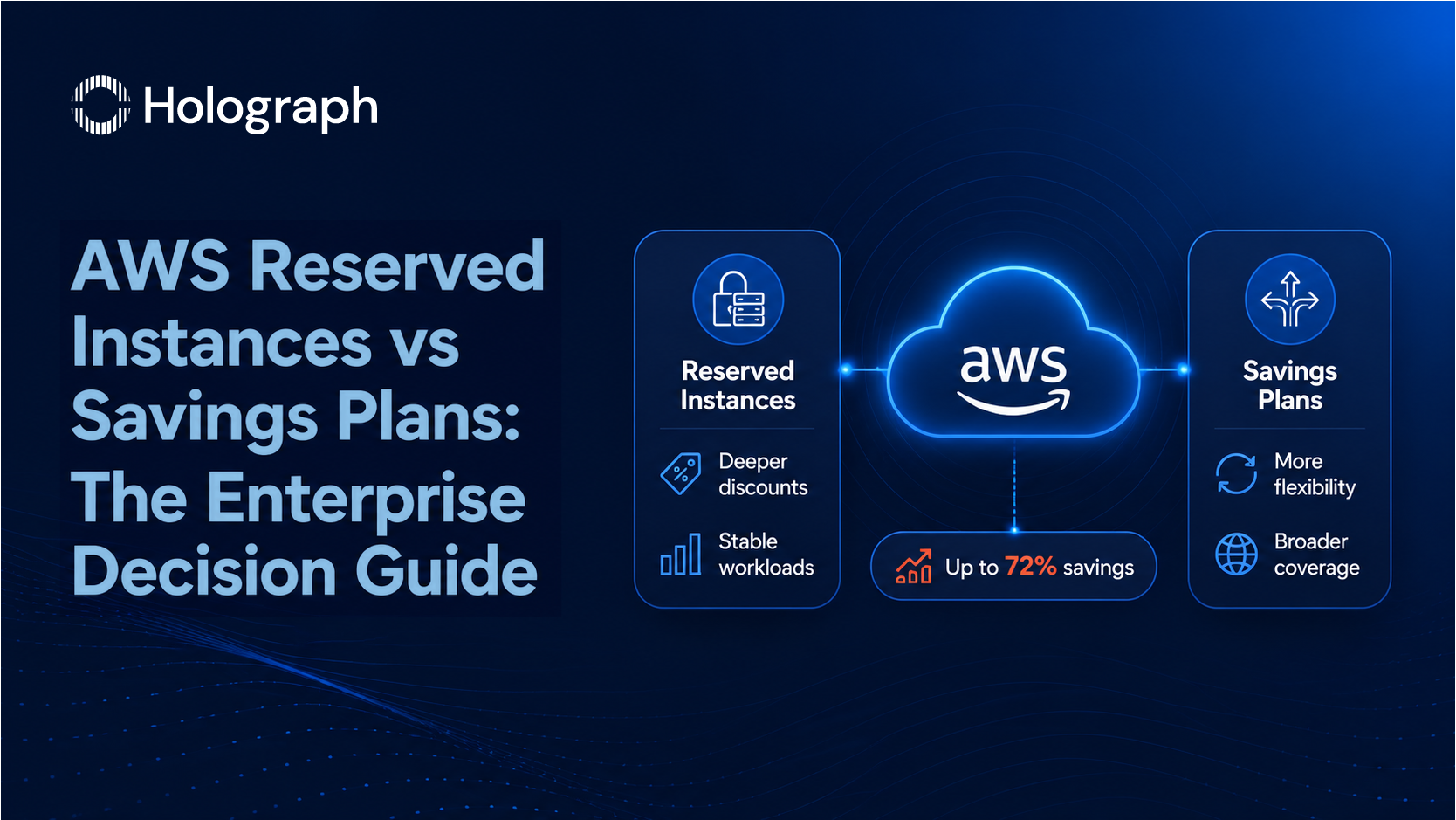
AWS offers multiple commitment-based discount mechanisms that provide significant savings compared to on-demand pricing. Reserved Instances deliver 30-40% savings depending on commitment length and payment option. Savings Plans provide similar discounts with greater flexibility, applying across instance families, regions, and compute services. The challenge lies in optimizing commitment strategy to maximize savings while minimizing risk from future usage changes.
53% of total AWS spend attributes to Amazon EC2, AWS Lambda, and AWS Fargate, suggesting that 60% or more of usage before discounts involves compute. This concentration means compute commitment optimization delivers disproportionate impact on overall cloud spending. Organizations that optimize compute commitments effectively can achieve Effective Savings Rates exceeding 40% compared to on-demand pricing.
Database Savings Plans launched in 2025, enabling up to 35% savings via one-year commitments. These plans support both Intel and Graviton instances across Generation 7 and above, covering serverless and provisioned deployment models. This expansion means organizations can now optimize commitment strategy across broader range of AWS services beyond compute.
Commitment flexibility proves critical for sustained optimization. Horizontal flexibility refers to commitments' ability to shift across different services or resource types based on attributes like product, instance family, and region. Compute Savings Plans excel at horizontal flexibility, which explains their popularity. Vertical flexibility describes the ability to increase or decrease total commitment value to match changing usage levels. This flexibility mitigates risks from under-commitment and over-commitment as workloads evolve.
51% of organizations using commitments utilize infrequent batch purchases of AWS Savings Plans over sophisticated strategies. The most popular commitment type remains the three-year Compute Savings Plan because it requires minimal ongoing management and covers broad compute service range. However, this simplistic approach leaves significant optimization opportunities untapped as usage patterns shift over time.
Sophisticated commitment strategies combine multiple discount mechanisms to maximize savings while managing risk. Organizations might blend one-year and three-year commitments to balance flexibility with deeper discounts. Combining Reserved Instances for predictable workloads with Savings Plans for variable usage creates portfolios that adapt to changing requirements. The key lies in continuous analysis and adjustment as usage patterns evolve.
Automation becomes essential for optimal commitment management. Manual analysis cannot keep pace with dynamic cloud environments where workloads scale continuously. Third-party FinOps platforms leverage algorithms and AI to optimize Effective Savings Rate while minimizing commitment risk. These platforms analyze usage patterns, predict future requirements, and automatically adjust commitment portfolios to maintain optimal coverage.
Cost Allocation and Accountability Through Tagging
Cost visibility without attribution provides limited value. Organizations need granular understanding of which applications, teams, and business units drive spending. This attribution enables showback and chargeback mechanisms that create accountability for cloud consumption. Tagging strategies provide the foundation for accurate cost allocation across organizational dimensions.
AWS Cost Categories enable organizations to map costs to business structures regardless of tagging consistency. Categories can combine tags, accounts, services, and charges into logical groups that reflect how businesses actually operate. This flexibility proves valuable when tagging strategies evolve or when acquiring companies with different tagging conventions.
Effective tagging requires governance from the beginning. Organizations should establish tagging policies before significant AWS adoption occurs. Retrofitting tags across thousands of resources proves far more difficult than implementing tags during resource creation. Tag enforcement through AWS Organizations Service Control Policies prevents resource creation without required tags, ensuring consistency as adoption expands.
The challenge with tagging extends beyond technical implementation to organizational behavior. Development teams view tagging as overhead that slows deployment velocity. Finance teams require detailed cost attribution for accurate departmental accounting. Balancing these competing priorities requires finding minimum viable tagging that satisfies financial requirements without imposing excessive burden on engineering.
Amazon democratizes cost data by putting visibility in front of builders, leaders, finance, and FinOps teams, not just siloing it within operational groups. This transparency enables teams to see how their decisions impact costs in real-time rather than discovering consequences weeks later through monthly reports. When developers understand cost implications during development, they make better architectural decisions that balance functionality with efficiency.
Unit economics provide powerful cost attribution by tying spending to business metrics. Rather than reporting total infrastructure costs, organizations track cost per transaction, cost per user, or cost per API call. These metrics reveal efficiency trends that absolute spending obscures. A doubling of infrastructure costs might represent waste or might reflect successful business growth. Unit economics distinguish between these scenarios by showing whether costs grow proportionally to business value.
Leveraging AI and Automation for Continuous Optimization
AWS Cost Optimization Hub now integrates with Amazon Q Developer to simplify cost optimization through natural language interaction. Practitioners can ask cost analysis and optimization questions without memorizing different filter combinations. The system provides recommendations based on expert-validated models that scale to millions of AWS resources, with accurate savings estimates that rationalize overlapping opportunities.
This AI-enhanced approach represents evolution from reactive cost management to proactive optimization. Traditional processes require teams to manually analyze spending, identify opportunities, and implement changes. AI-powered systems continuously monitor environments, detect anomalies, and recommend optimizations automatically. Some systems even implement approved optimizations without human intervention, operating at scales impossible through manual processes.
The key to effective automation lies in multi-objective optimization. Simply minimizing costs without considering performance and availability creates more problems than it solves. Intelligent systems must balance cost efficiency with service level requirements. Advanced platforms use specialized agents that monitor cost, performance, and availability separately, implementing only changes that preserve SLA commitments while reducing spending.
Automation also addresses the human capacity constraint that limits optimization efforts. Most organizations report more optimization work exists than capacity to execute it, creating backlogs of known improvements that never get implemented. Automated systems work continuously without capacity constraints, systematically addressing opportunities that manual processes miss due to time limitations.
Building Organizational FinOps Capability
Technology and tools represent only part of effective cost optimization. Organizational capability determines whether optimization efforts deliver sustained value or stall after initial enthusiasm fades. The most successful organizations formalize FinOps through dedicated teams, established processes, and executive sponsorship that maintains focus over time.
Cloud Centers of Excellence or FinOps teams centralize expertise and establish best practices organization-wide. These teams develop standards, provide training, and guide optimization initiatives across business units. Creating role-specific cost visibility dashboards enables builders to answer their own questions about cost implications rather than waiting for centralized analysis.
Education proves critical for sustainable optimization. Engineers make architectural decisions with cost implications throughout development cycles. When these teams understand cloud economics and financial impact of technical choices, they naturally optimize during design rather than requiring retrofitting after deployment. Regular training on AWS cost optimization principles, combined with feedback loops that show actual spending impacts, builds capability that persists as team members change roles.
Establishing clear metrics and KPIs ensures teams focus on impact rather than just effort. Effective Savings Rate measures commitment discount effectiveness. Cost per workload tracks whether spending grows proportionally to business value. Unit economics like cost per transaction or cost per customer reveal efficiency trends over time. These metrics should be reviewed monthly and tied to team-level goals, creating accountability for optimization outcomes.
Celebrating teams that reduce waste, improve coverage, or make better architectural decisions reinforces desired behaviors. Cost optimization can feel thankless when success means absence of problems rather than visible achievements. Recognition programs that highlight successful optimization efforts encourage continued focus on efficiency.
Integrating Cost Optimization with Modernization
Cost optimization and cloud modernization through advanced services create synergistic benefits when pursued together. Applications refactored to leverage serverless computing, managed databases, and content delivery networks often achieve better performance at lower cost compared to lift-and-shift migrations. The modernization investment pays for itself through operational efficiency gains and reduced infrastructure spending.
Serverless architectures eliminate idle resource costs by charging only for actual compute time. AWS Lambda bills by millisecond with no charges for idle periods. For variable workloads, this pricing model dramatically reduces costs compared to always-on servers that sit idle during low-traffic periods. Organizations running event-driven workloads see 40-60% cost reductions when properly architecting for serverless.
Containerization with Amazon ECS or EKS enables higher resource utilization through improved workload density. Multiple application components can share compute infrastructure efficiently, eliminating waste from dedicated servers running single applications. Combined with intelligent scheduling and auto-scaling, containerized architectures optimize resource utilization dynamically based on actual demand.
Managed database services trade slightly higher hourly costs for eliminated operational overhead and better resource efficiency. Amazon RDS automates backups, patching, monitoring, and failover while providing better utilization than self-managed databases. When factoring in operational effort savings alongside infrastructure costs, managed services frequently deliver better total cost of ownership despite higher per-hour pricing.
Conclusion
AWS cost optimization in 2026 requires treating financial operations as core engineering discipline rather than periodic cleanup exercise. Organizations that embed FinOps practices into technical decision-making consistently achieve better outcomes than those treating cost as afterthought. Success demands combining technical optimization strategies with organizational capability building, recognizing that technology alone cannot overcome poor governance and accountability.
The strategies outlined here represent proven approaches delivering measurable results across diverse organizations. Rightsizing eliminates waste from overprovisioned resources. Commitment-based discounts capture savings for predictable workloads. Tagging and cost allocation create accountability. AI and automation scale optimization beyond manual capacity limits. These tactics work when applied systematically with executive sponsorship and cross-functional collaboration.
The opportunity cost of suboptimal cloud spending compounds over time as applications proliferate and usage expands. Organizations that master cost optimization in 2026 redirect savings toward innovation initiatives that drive competitive advantage. With proven strategies, native AWS tools, and mature partner ecosystem, achieving world-class cost efficiency has never been more accessible for enterprises committed to treating cloud spending as strategic investment requiring active management.
AEO Questions for Voice Search Optimization
1. How can organizations reduce AWS cloud waste in 2026? Organizations reduce AWS cloud waste through rightsizing overprovisioned resources, eliminating idle infrastructure, implementing commitment-based discounts, establishing tagging governance for cost attribution, and automating optimization through FinOps platforms. Research shows up to 47% of cloud budgets are wasted on underutilized resources. AWS Compute Optimizer provides rightsizing recommendations, while Cost Explorer identifies idle resources. The key lies in treating optimization as continuous discipline rather than one-time cleanup.
2. What are the best AWS cost optimization strategies? Best strategies include implementing FinOps practices across three phases (Inform, Optimize, Operate), rightsizing compute and storage resources based on actual utilization, leveraging Savings Plans and Reserved Instances for predictable workloads, establishing cost allocation through tagging governance, and automating optimization using AI-powered tools. Organizations should pursue sophisticated commitment strategies rather than simple batch purchases, combine multiple discount mechanisms, and tie cost optimization to business metrics through unit economics.
3. How does FinOps improve AWS cost management? FinOps improves cost management by integrating financial accountability into technical decision-making, providing visibility and attribution through detailed cost data, establishing cross-functional collaboration between engineering and finance teams, and creating continuous optimization processes. Organizations practicing FinOps move from monthly reviews to hourly optimization actions, democratize cost data across teams, and implement automated systems that detect anomalies and recommend improvements. Mature FinOps teams demonstrate 20-25% annual cost savings through continuous optimization.
4. What AWS tools help optimize cloud costs effectively? AWS provides Cost Explorer for spending analysis, Cost and Usage Reports for granular data, AWS Compute Optimizer for rightsizing recommendations, Cost Optimization Hub for centralized optimization management, AWS Budgets for proactive spending alerts, and Trusted Advisor for discount-aware recommendations. Recent enhancements include Amazon Q integration for natural language cost analysis, Aurora I/O Optimized recommendations, and automated optimization workflows. Third-party FinOps platforms complement native tools with sophisticated commitment management and multi-objective optimization.