AWS Cost Optimisation: The Enterprise Leader's Guide to Reducing Cloud Spend
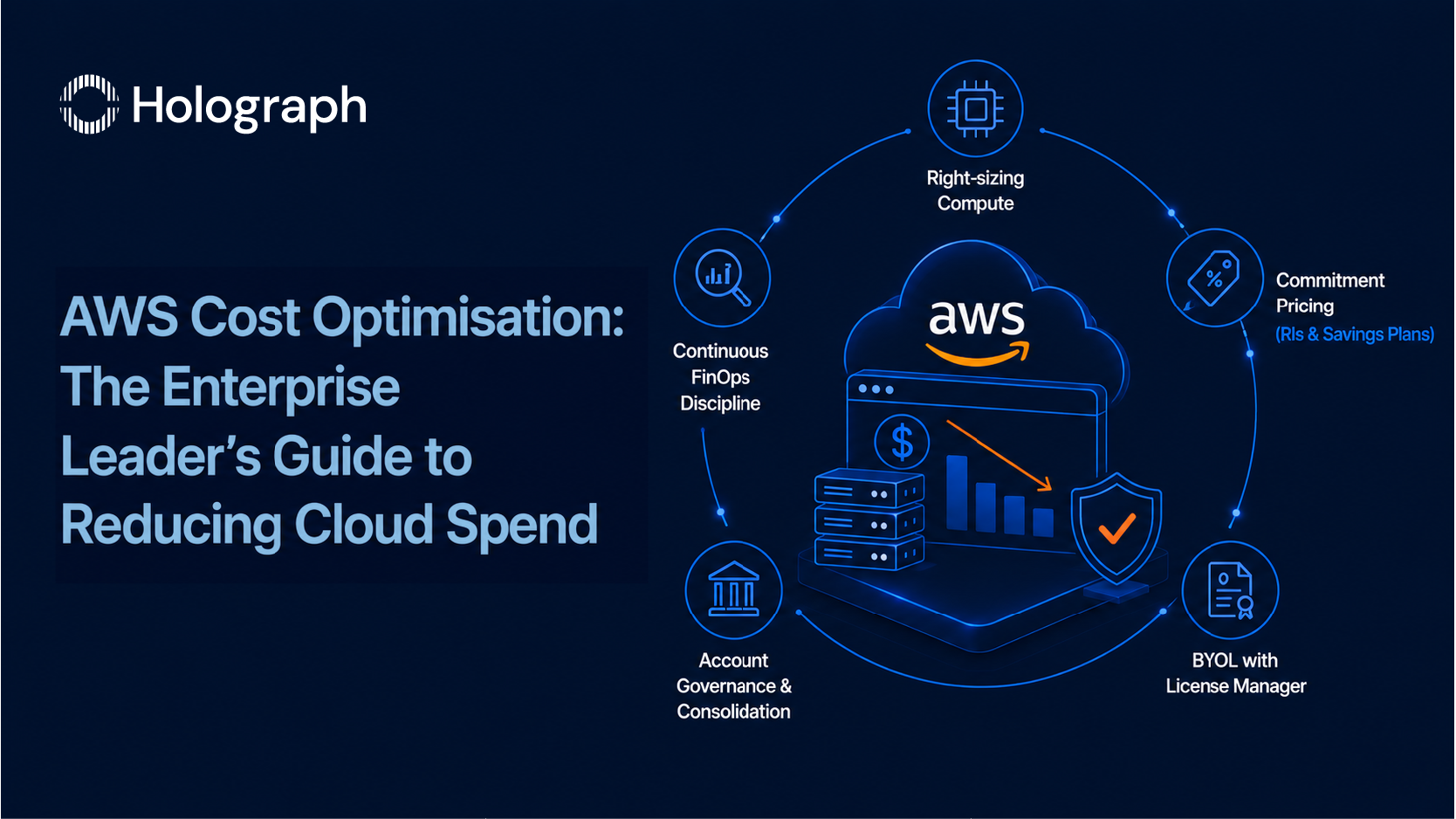
AWS Cost Optimisation: The Enterprise Leader's Guide to Reducing Cloud Spend
AWS bills have a structural tendency to grow. Enterprises provision capacity for peaks, teams create accounts faster than finance can track, and workloads that were supposed to be temporary run for eighteen months. According to Gartner, organisations waste an average of 30 per cent of their cloud spend. The problem is rarely the wrong cloud. It is the default configuration, which happens to be the most expensive one AWS offers.
This guide covers the four structural levers that reduce enterprise AWS costs without a migration, a platform change, or service disruption. It also describes what a cost optimisation engagement looks like in practice, because most organisations have the intent but not the internal bandwidth to run one while normal operations continue.
Why Enterprise AWS Bills Keep Growing
The default state of an AWS environment is expensive. On-demand pricing is where every new workload starts. It is also the pricing model that charges the most, because it carries no usage commitment. Most workloads never leave it.
Over time, three patterns compound the problem. The first is account proliferation. Teams in large enterprises create separate AWS accounts for each project, environment, or business unit. Each account carries its own billing and its own on-demand pricing, with no volume consolidation. An organisation running 20 separate AWS accounts loses every benefit of AWS's volume discount structures and pays for duplicate services across each one.
The second is unused and oversized compute. Provisioning to handle peak load leaves capacity idle for the other 28 days of the month. A database server sized for end-of-month reporting runs at 15 per cent utilisation the rest of the time. Development environments left running over weekends and public holidays consume budget with no output. These are straightforward to identify, but without a governance process, nobody is looking.
The third is the least visible: paying for software the enterprise already owns. AWS offers instance types that bundle the operating system and software into the hourly compute rate. Running Windows Server or SQL Server on a licence-included instance is convenient at launch. Enterprises with existing volume licence agreements pay twice: once through the AWS instance price, and again through the licence agreement they already hold. AWS License Manager and Bring Your Own Licence (BYOL) both address this, but they require deliberate setup rather than happening automatically.
Each pattern is individually solvable. Most enterprises are running all three at once.
The Four Levers of AWS Cost Optimisation
Sustainable cost reduction on AWS draws on four levers in combination. Each targets a different category of spend. Applying only one or two captures partial savings; applying all four, in the right sequence, changes the cost structure.
Lever 1: Right-Sizing Compute Resources
Right-sizing aligns instance type and size to actual workload requirements rather than peak estimates or initial assumptions. AWS Cost Explorer and AWS Compute Optimizer both surface right-sizing recommendations. The tools are useful, but they address current oversizing, not the process that causes new workloads to be over-provisioned in the first place.
Auditing CPU, memory, and network utilisation across accounts typically surfaces 20 to 30 per cent of compute running significantly oversized. Resizing that compute reduces the cost baseline before any commitment pricing is applied. The sequence matters. Purchasing Reserved Instances for oversized instances locks in the wrong spend level for one to three years. Right-sizing first, then buying commitment coverage, is the correct order.
Lever 2: Commitment Pricing (Reserved Instances and Savings Plans)
For predictable workloads, on-demand pricing is avoidable. AWS provides two commitment pricing models that reduce per-hour costs substantially in exchange for a usage commitment.
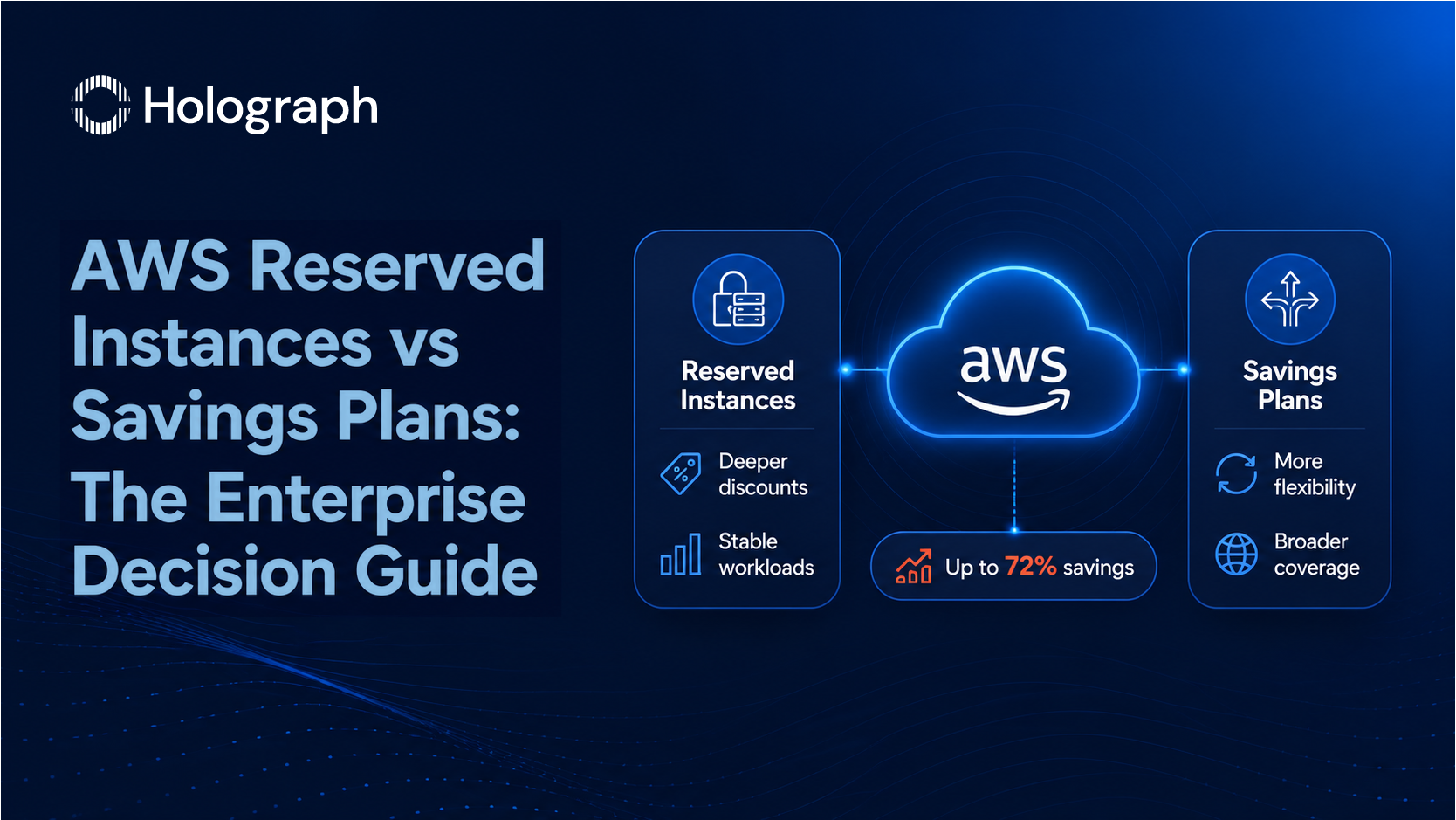
Reserved Instances (RIs) commit to a specific instance type in a specific region for one or three years. Standard Reserved Instances offer up to 72 per cent savings compared to on-demand pricing. The trade-off is specificity: the commitment ties to a particular instance family, size, operating system, and region.
Savings Plans commit to a consistent spend level (measured in dollars per hour) across any instance family, size, region, and operating system. Compute Savings Plans offer discounts of up to 66 per cent versus on-demand. The flexibility makes them the default commitment vehicle for most enterprise compute workloads in 2026, particularly given changes to Reserved Instance portability policies that came into effect in mid-2025.
Most organisations use neither model well. A common pattern: a small pool of Reserved Instances purchased early, then left static as the environment grows. The result is that 80 to 90 per cent of compute runs on on-demand while a small slice benefits from commitment discounts.
The right approach is not choosing between the two models but layering them: Compute Savings Plans cover the predictable baseline; Reserved Instances cover specific workloads, particularly database tiers, where instance-level capacity reservation has operational value. The full breakdown of when to use each model and how to build the layering strategy is in AWS Reserved Instances vs Savings Plans: The Enterprise Decision Guide.
Lever 3: BYOL and AWS License Manager
Software licensing costs are embedded in AWS pricing in a way that is easy to overlook on a billing dashboard. Licence-included instances price the software into the hourly compute rate. For an enterprise that holds volume licences for those products under an existing Microsoft Enterprise Agreement or Oracle agreement, that instance pricing represents paying for the same software twice.
AWS License Manager resolves this by tracking existing licence inventory and applying those licences to EC2 instances instead of using the AWS-bundled versions. The instances run on BYOL pricing, which removes the software cost component from the hourly rate. License Manager also enforces licence limits, flags over-deployment relative to entitlements, and tracks usage across multiple accounts, which addresses the compliance risk that comes with untracked BYOL deployments.
The savings vary by workload and the size of the existing Microsoft or Oracle licence estate. The implementation process, supported licence types, and multi-account management are covered in AWS License Manager and BYOL: How Enterprises Reduce Software Licensing Costs.
Lever 4: Account Governance and Consolidation
Multiple payer accounts fragment billing, eliminate volume discount benefits, and duplicate fixed costs such as AWS Support plans. AWS Organizations consolidated billing addresses the discount problem directly: all accounts within an organisation pool their usage, and the combined spend qualifies for AWS volume discount tiers. Reserved Instances and Savings Plans purchased in one account apply to matching usage across member accounts.
Beyond billing consolidation, governance infrastructure stops the waste before it accumulates. Tagging policies enforce cost allocation by team, project, and environment. Service Control Policies prevent teams from launching instance types outside approved parameters. Budget alerts surface cost anomalies before they compound.
Account consolidation requires sequencing, particularly where teams hold separate billing relationships or enterprise agreements with AWS. The structural savings are immediate once consolidation is in place. A Holograph engagement with a technology client consolidated 19 AWS accounts to 14, established governance and documentation where neither had existed previously, and reduced monthly AWS costs by 34.5 per cent over four months. The consolidation process is detailed in AWS Account Consolidation: How Multi-Account Governance Cuts Cloud Costs.
What an AWS Cost Optimisation Engagement Looks Like
Most enterprises have the technical capability to implement individual optimisation measures. The challenge is that the work spans billing analysis, architecture review, licence inventory, and account restructuring simultaneously while normal engineering operations continue. It tends to get deferred.
A structured engagement runs in four phases.
Discovery and audit (weeks 1–3). Billing data and usage metrics are pulled across all accounts. The audit identifies what is running, what it costs, and which of the four levers apply with what estimated savings. The output is a ranked savings analysis with recommendations sorted by impact and implementation effort.
Quick wins (weeks 3–6). Right-sizing and commitment pricing adjustments can be made without organisational change. Oversized instances are resized. Reserved Instance and Savings Plan coverage is extended to predictable workloads. These two moves typically deliver the majority of savings within the first 60 days.
Structural changes (weeks 4–12). BYOL migration and account consolidation take longer: they involve licence agreement review, account restructuring, and governance implementation. Both deliver sustained, compounding savings. Account consolidation in particular changes the cost structure permanently rather than delivering a one-time reduction.
Ongoing management. Cost optimisation is not a project with an end date. Workloads change, new accounts are created, and commitment pricing coverage drifts as usage evolves. Monthly reviews and quarterly governance checks sustain the savings achieved in the initial engagement.
Common Mistakes That Keep Enterprise AWS Bills High
Running predictable workloads on on-demand pricing for years is the most common and most costly mistake. Production web applications, databases, and internal services that run continuously are candidates for Reserved Instances or Savings Plans. Organisations that treat commitment pricing as optional for anything except their largest workloads leave significant savings sitting in the on-demand billing line.
Buying Reserved Instances before right-sizing is the second mistake. It locks in overspend for the term of the commitment. Right-size the workload first, confirm the stable baseline, then purchase commitment coverage.
Maintaining multiple payer accounts for billing clarity deserves scrutiny. The same cost allocation visibility can be achieved through tagging policies and cost allocation reports inside a single AWS Organization, without the account sprawl and without losing volume discount pooling.
Running licence-included instances for software already owned is often invisible on the AWS bill because the software cost is embedded in the instance price rather than listed separately. A licence audit surfaces these instances. Without one, the overspend continues unnoticed on every billing cycle.
Treating cost optimisation as a one-time project is what turns a successful 30-day initiative into a problem that returns within 18 months. New workloads default to on-demand. New teams spin up new accounts. BYOL compliance drifts. The organisations that sustain low AWS bills embed cost governance into standing operational processes rather than returning to it as a remediation exercise.
Building a Continuous AWS Cost Optimisation Programme
The four levers deliver the initial cost reduction. A governance programme sustains it.
Monthly, cost anomaly detection in AWS Cost Management surfaces unusual spend increases within days. Monthly billing reviews by account and team confirm that commitment pricing coverage tracks planned workload levels.
Quarterly, Reserved Instance and Savings Plan coverage is reviewed against current and planned usage. Right-sizing recommendations from Compute Optimizer are assessed and actioned. Idle instances, orphaned EBS volumes, and forgotten snapshots are identified and removed.
Annually, a full account governance audit reviews account structure, enterprise agreement terms, and licence inventory to identify new BYOL opportunities as workloads evolve.
The enterprises with the lowest AWS bills relative to their workload are not the ones that ran the most aggressive one-time optimisation. They are the ones that made cost visibility a standing operational function rather than a quarterly fire drill.
Holograph holds AWS Advanced Tier Services Partner status and delivers cost optimisation engagements for enterprise clients across the USA, UAE, KSA, and India. The engagement covers all four levers: right-sizing, commitment pricing, BYOL implementation, and account governance.
Frequently Asked Questions
What are the main drivers of high AWS costs for enterprises?
Four patterns drive most enterprise AWS overspend: running predictable workloads on on-demand pricing rather than Reserved Instances or Savings Plans; operating multiple separate AWS accounts without consolidated billing; running licence-included instances for software the enterprise already holds volume licences for; and provisioning instances to handle peak load without a governance process to right-size them when peak demand passes. Each pattern is addressable without migrating workloads or changing architecture.
How much can an enterprise save by optimising AWS costs?
Savings depend on the starting baseline. Organisations that have not previously applied commitment pricing typically achieve 30 to 72 per cent reductions on eligible compute through Reserved Instances and Savings Plans alone. Account consolidation adds volume discount benefits and eliminates duplicate fixed costs. AWS's own Optimization and Licensing Assessment programme reports an average total cost of ownership reduction of 36 per cent across assessed accounts. Client engagements Holograph has completed show that structurally uncommitted environments can achieve reductions in monthly AWS costs above 30 per cent within a four-month engagement.
What is the difference between AWS cost optimisation and cloud migration?
Cloud migration moves workloads from on-premises or another cloud environment to AWS. AWS cost optimisation reduces the cost of workloads already running on AWS. The two are independent. An enterprise does not need to migrate workloads or change its architecture to reduce its AWS bill. Right-sizing, commitment pricing, account governance, and BYOL all apply to existing workloads as they currently run.
What is the first step in reducing enterprise AWS cloud spend?
The first step is a billing and usage audit. Before purchasing Reserved Instances, switching to BYOL, or restructuring accounts, an enterprise needs accurate data on what is running, what it costs per account, and how utilisation compares to provisioned capacity. Purchasing commitment pricing without a usage baseline is the most common cause of wasted RI spend.
What is the AWS Optimization and Licensing Assessment (OLA)?
The AWS OLA is a programme offered by AWS and its partner network to assess an organisation's current on-premises and cloud environments. It analyses resource utilisation, third-party software licensing, and application dependencies to identify cost reduction opportunities. AWS Finance benchmark data shows organisations that complete an OLA achieve an average total cost of ownership reduction of 36 per cent. AWS Advanced Tier Services Partners are qualified to deliver OLA engagements.
How do Reserved Instances and Savings Plans reduce AWS costs?
Reserved Instances and Savings Plans are commitment pricing models: the organisation commits to a consistent usage level for one or three years in exchange for a reduced per-hour rate. Standard Reserved Instances provide up to 72 per cent savings compared to on-demand pricing for specific instance types. Compute Savings Plans provide up to 66 per cent savings with greater flexibility across instance families, sizes, and regions. Both models apply most effectively to workloads that run at consistent levels: production databases, web application tiers, and internal services that run continuously.
Can AWS cost optimisation be done without disrupting production workloads?
Yes. Right-sizing requires a planned instance restart, schedulable during a maintenance window. Reserved Instance and Savings Plan purchases apply to running workloads with no operational change. BYOL migration requires a licence review and instance replacement but no workload migration. Account consolidation under AWS Organizations can be completed without changing workload configuration. The majority of structural AWS savings require no service disruption beyond brief, planned maintenance windows.
Holograph delivers AWS cost optimisation engagements for enterprise clients across the USA, UAE, KSA, and India, covering right-sizing, commitment pricing, BYOL implementation, and account governance. Review your AWS cost structure with the Holograph team.