AWS Reserved Instances vs Savings Plans: The Enterprise Decision Guide
Every AWS workload that runs at a consistent level and sits on on-demand pricing represents a decision that was never made. On-demand is the default; commitment pricing requires deliberate action. That gap between the default rate and the commitment rate is where most enterprise AWS overspend accumulates.
AWS provides two commitment pricing models to address this: Reserved Instances and Savings Plans. Both offer substantial discounts compared to on-demand rates. Both require a usage commitment in exchange for those discounts. The differences between them determine which model is the better fit for a given workload, and for most enterprise environments, the answer is not either/or.
This post explains how each model works, where each performs best, and how to layer them to maximise commitment pricing coverage across a complex AWS environment. For the broader framework of enterprise AWS cost reduction, see AWS Cost Optimisation: The Enterprise Leader's Guide to Reducing Cloud Spend.
What Are AWS Reserved Instances?
A Reserved Instance is a billing commitment to use a specific amount of EC2 capacity. When the commitment is active, AWS charges the Reserved Instance rate rather than the on-demand rate for matching usage.
Three types of Reserved Instances are available:
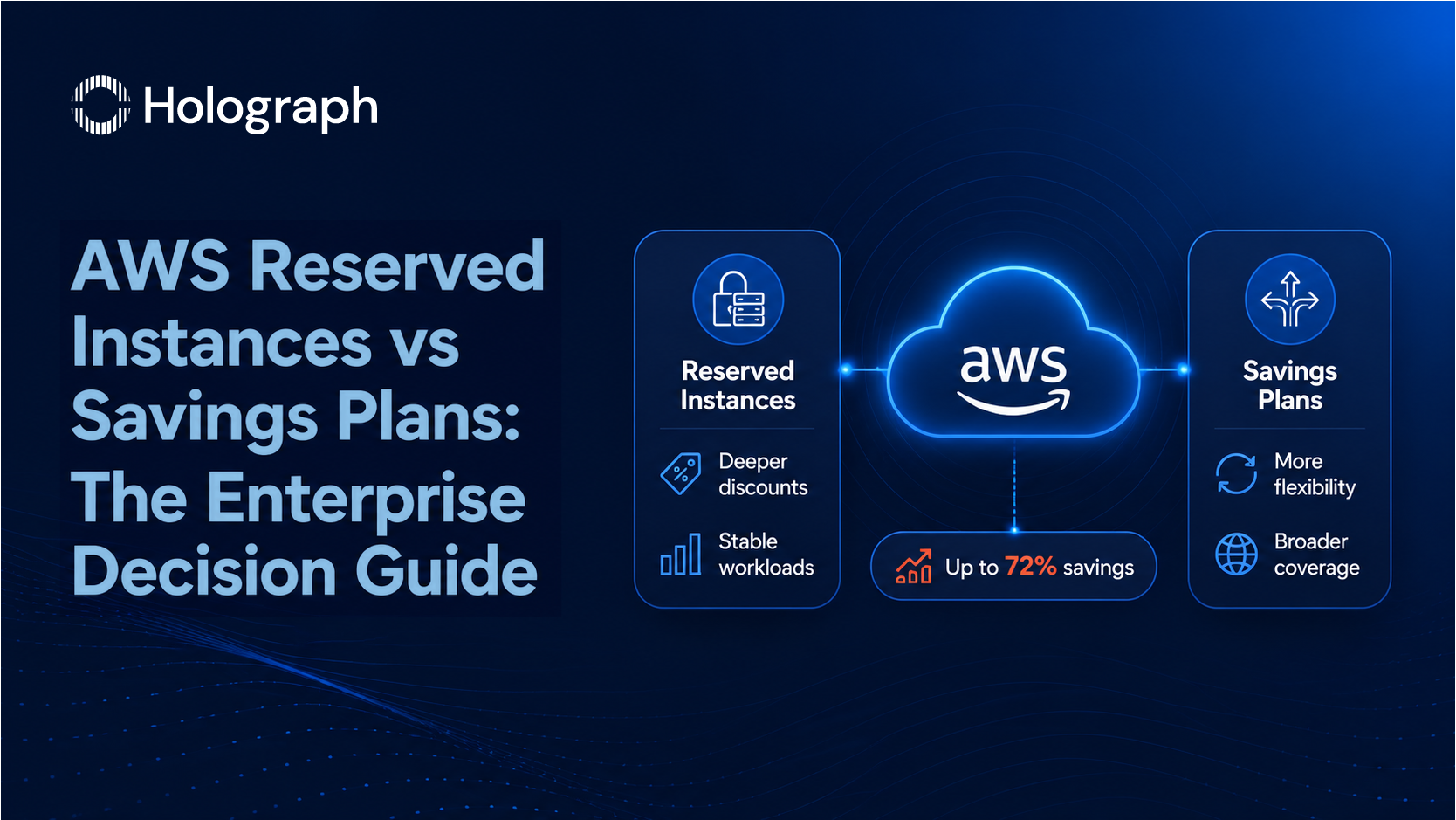
Standard Reserved Instances offer the deepest discounts: up to 72 per cent savings compared to on-demand pricing. The trade-off is specificity. A Standard RI commits to a particular instance family and size, operating system, tenancy, and region. An RI purchased for an m5.xlarge running Linux in eu-west-1 applies only to that exact configuration. It cannot be applied to a different instance family or a different region.
Convertible Reserved Instances offer up to 66 per cent savings, the same as the more flexible Compute Savings Plans. The convertible type allows changes to instance family, operating system, and tenancy during the reservation term. This flexibility costs approximately 6 to 10 percentage points of discount compared to Standard RIs.
Scheduled Reserved Instances are no longer offered for new purchases. Existing scheduled commitments continue to run, but this type is not part of a current commitment pricing strategy.
Reserved Instances are available on one-year or three-year terms, with three payment structures: all upfront (highest discount), partial upfront, and no upfront (lowest discount within the RI type, but still substantially below on-demand). Three-year terms provide an additional discount of approximately 10 percentage points over equivalent one-year commitments.
Standard Reserved Instances can also be listed on the AWS Marketplace for resale if the commitment becomes unnecessary before the term ends. Enterprise Discount Program customers should note that as of early 2024, EDP-discounted RIs cannot be listed on the Marketplace.
What Are AWS Savings Plans?
Savings Plans are a commitment pricing model introduced by AWS in 2019 as a more flexible alternative to Reserved Instances. Instead of committing to a specific instance configuration, an organisation commits to a consistent spend level, measured in dollars per hour, across eligible services.
Two Savings Plans types are relevant for enterprise compute:
Compute Savings Plans provide up to 66 per cent savings compared to on-demand pricing and apply across any EC2 instance family, size, region, operating system, and tenancy. They also apply to AWS Lambda and AWS Fargate usage. The flexibility is the defining attribute: a Compute Savings Plan continues to apply regardless of how the instance configuration changes over the commitment term.
EC2 Instance Savings Plans provide discounts of up to 72 per cent, the same ceiling as Standard RIs. The trade-off: they apply to a specific instance family in a specific region, though any size, OS, or tenancy within that family qualifies. An EC2 Instance Savings Plan for m5 instances in eu-west-1 applies to any m5.large, m5.xlarge, m5.2xlarge, and so on, in that region. This is meaningfully more flexible than a Standard RI while achieving comparable discount levels for workloads that stay within a single instance family.
Savings Plans are purchased in the AWS Cost Management console and apply automatically to matching eligible usage across the AWS account, or across an AWS Organization with consolidated billing enabled.
The Central Trade-Off: Flexibility vs. Specificity
The practical difference between Reserved Instances and Savings Plans comes down to how precisely an organisation can predict its future usage.
Standard Reserved Instances require knowing the instance type, size, operating system, region, and tenancy for the next one or three years. For a production Oracle database on a specific instance type that will not change, that specificity is realistic. For a web application tier that is periodically right-sized, resized, or moved across regions, that specificity is a constraint.
Compute Savings Plans require knowing only how much the organisation will spend on eligible compute per hour over the commitment term. That is a much simpler prediction. An organisation that plans to spend at least $5 per hour on compute can purchase a $5/hour Compute Savings Plan and let AWS apply it to whatever eligible usage best matches — automatically, with no configuration changes required.
The 6 percentage point difference in maximum discount (72 per cent for Standard RIs versus 66 per cent for Compute Savings Plans) is the cost of that flexibility. For most workloads, the flexibility is worth more than the additional 6 per cent discount, particularly because the penalty for getting an RI wrong — an unused commitment for one to three years — is far more expensive than the smaller savings gap.
When Reserved Instances Outperform Savings Plans
Reserved Instances remain the right choice in specific scenarios.
Database tiers with stable configurations. RDS Reserved Instances apply to database instances and are not covered by EC2 Savings Plans. ElastiCache, Redshift, OpenSearch, and other managed services also offer RI-style commitment pricing without a Savings Plans equivalent. For any managed service workload running predictably at a fixed configuration, RIs are the only commitment pricing tool available.
Capacity reservation requirements. Standard Reserved Instances provide a capacity reservation in the selected Availability Zone. That reservation guarantees access to the instance capacity even during periods of high demand in the region. Savings Plans and Convertible RIs do not include capacity reservations by default. For workloads where compute availability is a business-critical requirement, the Standard RI capacity reservation has operational value beyond the cost discount.
Maximum discount on confirmed long-term workloads. When an instance configuration has been stable for two or more years and is expected to remain stable, a 3-year Standard RI All Upfront provides the highest discount available. The additional 6 per cent over Compute Savings Plans compounds materially over a three-year term for large instance types.
EC2 Instance Savings Plans as a middle ground. For organisations that want the depth of discount approaching Standard RIs but need size flexibility within an instance family, EC2 Instance Savings Plans provide up to 72 per cent savings without committing to a specific instance size. This is often the right choice for application tiers that scale vertically but stay within the same instance family.
When Savings Plans Outperform Reserved Instances
Compute Savings Plans are the more effective primary commitment vehicle for the majority of enterprise compute in 2026.
Evolving application architectures. Applications that change instance types as they are optimised, refactored, or migrated across regions will regularly break the match condition of a Standard RI. A Compute Savings Plan continues to apply regardless of those changes.
Containerised and serverless workloads. Compute Savings Plans apply to Fargate and Lambda usage. Reserved Instances do not. For organisations running significant containerised workloads or serverless functions alongside EC2, Savings Plans provide coverage that RIs cannot.
Multi-region deployments. Standard RIs are locked to a specific region. Compute Savings Plans apply globally. An organisation that runs workloads across multiple AWS regions, or that is in the process of expanding its regional footprint, benefits from the cross-region coverage.
Organisations earlier in their commitment pricing journey. A Compute Savings Plan based on confirmed baseline spend is a more forgiving starting point than a pool of Standard RIs for specific instance types. The plan applies to whatever the organisation is actually running, rather than requiring precise alignment between the commitment and the workload.
The Layering Strategy: How Enterprises Use Both Together
Choosing between Reserved Instances and Savings Plans is a less productive exercise than deciding how to layer them. Most enterprise environments benefit from a combination of the two.
A practical structure:
Step 1: Establish the Compute Savings Plan baseline. Analyse trailing usage data (90 days minimum, 12 months preferred) to identify the stable floor of compute spend. Purchase Compute Savings Plans to cover that floor. This provides 66 per cent savings on the largest, most predictable component of the bill with minimal risk of the commitment going unused.
Step 2: Identify RI candidates in managed services. RDS, ElastiCache, Redshift, and OpenSearch are not covered by Savings Plans. For each managed service running at a predictable configuration, purchase the appropriate RI type. These are the commitments most likely to produce stable, ongoing returns.
Step 3: Add EC2 Instance Savings Plans or Standard RIs for high-certainty application tiers. For application tiers that have operated on the same instance family for 18 or more months with no architectural changes planned, EC2 Instance Savings Plans or Standard RIs capture the additional discount above the Compute Savings Plan baseline.
Step 4: Leave headroom for on-demand. Commitment pricing works because the discount outweighs the risk of unused commitments. A coverage target of 70 to 80 per cent of consistent compute usage, rather than 100 per cent, provides the buffer to accommodate workload changes without generating wasted RI spend.
Within an AWS Organization with consolidated billing, Reserved Instances and Savings Plans purchased in one member account can apply to matching usage across other member accounts in the organisation. This significantly increases effective coverage without requiring each account to manage its own commitment purchasing. The governance structure for multi-account management is covered in detail in AWS Account Consolidation: How Multi-Account Governance Cuts Cloud Costs.
For enterprises running Windows Server, SQL Server, or Oracle workloads on EC2, BYOL is a complementary Pillar 1 lever that operates alongside commitment pricing: it removes the software licence cost from the hourly instance rate, reducing the baseline against which Reserved Instances and Savings Plans apply. The implementation is covered in AWS License Manager and BYOL: How Enterprises Reduce Software Licensing Costs.
Common Mistakes Enterprises Make with Commitment Pricing
Purchasing before right-sizing. This is the most costly sequencing error. Buying RIs or Savings Plans for oversized instances locks in the wrong spend level for the commitment term. Right-size the workload first; confirm the stable baseline; then purchase commitment coverage.
Setting coverage targets too high. Targeting 100 per cent coverage leaves no room for workload changes. An unused RI continues to accrue cost regardless of usage. A coverage target of 70 to 80 per cent on stable workloads, with on-demand for the remaining capacity, provides flexibility without significant cost impact.
Ignoring managed services. Organisations that use Savings Plans for EC2 workloads often overlook RDS, ElastiCache, and Redshift, where RI-style commitments are the only available discount mechanism. These managed service costs can represent 20 to 30 per cent of the total AWS bill.
Treating the commitment as a one-time decision. The relationship between commitment coverage and actual usage changes as workloads evolve. Quarterly reviews of RI and Savings Plan utilisation, using AWS Cost Explorer's coverage and utilisation reports, prevent coverage gaps from widening into meaningful on-demand overspend.
Missing the organisation-wide coverage opportunity. Enterprises running multiple AWS accounts without consolidated billing under AWS Organizations forgo the ability to share Reserved Instance and Savings Plan coverage across accounts. Each account then manages its own commitment purchasing, which both increases administrative overhead and reduces the effective discount coverage across the portfolio.
Holograph holds AWS Advanced Tier Services Partner status and delivers commitment pricing strategy as part of AWS cost optimisation engagements for enterprise clients across the USA, UAE, KSA, and India. For a review of your current commitment pricing coverage, see the AWS Cloud Services page.
(Pre-publish: confirm /service/cloud is the correct URL)
Frequently Asked Questions
What is the difference between AWS Reserved Instances and Savings Plans?
Reserved Instances commit to a specific instance configuration (type, size, OS, region, tenancy) in exchange for discounts of up to 72 per cent versus on-demand pricing. Savings Plans commit to a spend level per hour in exchange for discounts of up to 66 per cent (Compute Savings Plans) or 72 per cent (EC2 Instance Savings Plans). Savings Plans apply to any matching usage automatically; Reserved Instances apply only to the exact configuration purchased. Savings Plans are more flexible; Standard Reserved Instances can be more specific and therefore achieve marginally higher discounts in stable configurations.
Which saves more: AWS Reserved Instances or Savings Plans?
Standard Reserved Instances and EC2 Instance Savings Plans both offer up to 72 per cent savings versus on-demand. Compute Savings Plans offer up to 66 per cent. In practice, the difference in realised savings depends on how precisely the commitment matches actual usage. An RI that frequently goes unmatched because the workload changed delivers less effective savings than a Compute Savings Plan that applies continuously to whatever is running. The model with the better utilisation rate delivers more total savings, regardless of the headline discount percentage.
Can you use both Reserved Instances and Savings Plans at the same time?
Yes. AWS applies discounts in a defined order: EC2 Instance Savings Plans apply first, then Compute Savings Plans, then Reserved Instances, then on-demand rates. Most enterprise environments benefit from using both, with Compute Savings Plans as the primary commitment vehicle for EC2 and serverless workloads, and Reserved Instances covering managed services (RDS, ElastiCache, Redshift) where Savings Plans do not apply.
What is the AWS Enterprise Discount Program (EDP)?
The AWS Enterprise Discount Program is a volume commitment arrangement available to large enterprise customers. Customers commit to a minimum spend level over one to five years and receive a discount on their AWS usage in return. EDP customers should be aware that as of early 2024, EDP-discounted Reserved Instances cannot be listed for resale on the AWS Marketplace. Specific EDP terms should be reviewed with an AWS account manager or an AWS Advanced Tier Services Partner.
How do you calculate the right level of Reserved Instance coverage?
Start with 90 to 12 months of usage data from AWS Cost Explorer. Identify the minimum consistent compute usage level across that period (the floor, not the average). Purchase Savings Plans or Reserved Instances to cover 70 to 80 per cent of that floor, leaving headroom for workload changes. Review coverage quarterly using the RI Coverage and Savings Plans Coverage reports in Cost Explorer, and adjust commitments as the workload evolves.
What happens to unused Reserved Instances at the end of the term?
A Reserved Instance term that ends without being renewed simply reverts to on-demand pricing for that capacity. The discounted billing stops; the instances continue to run at full on-demand rates. Standard Reserved Instances can be listed for resale on the AWS Marketplace before the term ends if they are no longer needed (subject to current eligibility rules for the account type). There is no automatic renewal: organisations must actively decide whether to purchase new commitments.
Holograph delivers AWS commitment pricing strategy as part of cost optimisation engagements for enterprise clients across the USA, UAE, KSA, and India. Review your AWS cost structure with the Holograph team.