Why Cloud FinOps Fails Without Strong Software License Management
Key Takeaways
Introduction
The conversation around software license management FinOps integration has intensified over the past two years, and for good reason. FinOps adoption has accelerated faster than almost any IT discipline in recent memory. The FinOps Foundation's 2025 State of FinOps Report surveyed practitioners managing over $69 billion in cloud spend, and the 2026 edition found that 98% of respondents now track AI spend alongside their cloud budgets. The practice has earned its place in the enterprise cost management toolkit.
And yet, software license waste persists. Industry benchmarks consistently show that enterprises overspend by 20–30% on software licenses. That figure has barely moved in years, despite the rise of FinOps, despite increased investment in SAM tools, despite executive attention on IT cost optimization. The gap between what FinOps covers and what enterprises actually spend on software is where the waste lives.
This is not a criticism of FinOps. It is a diagnosis. Software license management FinOps practices were designed for different problems, and understanding where each excels is the first step toward improving software licensing management across the entire technology portfolio.
What FinOps Covers Well
Credit where it is due. FinOps has transformed how enterprises manage cloud infrastructure costs.
Cloud consumption optimization is the discipline's core strength. FinOps teams excel at right-sizing compute instances, identifying idle resources, optimizing reserved instance and savings plan coverage, and implementing tagging strategies that attribute cloud costs to business units. The tooling ecosystem supporting these capabilities has matured considerably since the FinOps Foundation formalized the practice. Platforms like CloudHealth, Spot.io, and Kubecost now give practitioners real-time visibility into resource utilization and spending trends that were entirely invisible five years ago.
Billing optimization adds another dimension of value. Commitment discount opportunities, billing anomaly detection, and cloud spend forecasting based on usage patterns all fall squarely within the FinOps wheelhouse, and the financial impact of getting these right is substantial for organizations running seven-figure cloud budgets.
The discipline also brings cultural value. FinOps established the principle of shared financial accountability for cloud resources, moving the conversation from "IT pays for cloud" to "every team is responsible for its consumption." That cultural shift matters, and its influence extends beyond cloud into broader technology spending behavior.
What FinOps Misses
The scope limitation is structural, not accidental. Understanding where software license management FinOps coverage falls short starts with acknowledging that FinOps was built for cloud infrastructure, and the discipline is only now beginning to stretch beyond that origin. The 2026 State of FinOps Report reveals the scale of the gap: while 90% of respondents now manage SaaS spend or plan to, only 2% of organizations have FinOps teams that cover cloud, SaaS, and AI holistically. The remaining 98% have blind spots.
SaaS seat licenses
The most consequential gap. Enterprise SaaS subscriptions — Atlassian Cloud, Microsoft 365, Adobe Creative Cloud, Google Workspace, Salesforce, ServiceNow — are priced per user, per tier. FinOps tools built for consumption-based cloud billing do not natively track whether a Microsoft 365 E5 license assigned to a marketing coordinator should actually be an E3, or whether 200 Confluence Premium seats could be downgraded to Standard without affecting anyone's workflow. That analysis requires a different kind of visibility: license entitlement data, user-level usage analytics, and vendor-specific pricing model expertise.
On-premises and hybrid entitlements
Many enterprises still maintain significant on-premises software estates alongside their cloud environments. Windows Server licenses, SQL Server entitlements, Oracle database agreements, and legacy application licenses carry material costs that FinOps dashboards do not surface. The hybrid use rights that govern whether on-premises licenses can be ported to cloud environments add another layer of complexity that falls outside the FinOps scope entirely.
Multi-vendor negotiation leverage
FinOps optimizes what you consume. It does not negotiate what you pay. Enterprise agreements with Microsoft, Adobe, Atlassian, and other major vendors are contract-based relationships where the terms, pricing, and renewal conditions are determined through negotiation, not through resource utilization dashboards. An enterprise might run a world-class FinOps practice on AWS while simultaneously overpaying by 20% on its Microsoft EA because nobody applied the same rigor to vendor negotiations.
Compliance and audit exposure
Cloud resource compliance (tagging, access policies, cost allocation) is well-covered by FinOps. Software license compliance is a different discipline altogether. Managing entitlements against deployments, tracking license mobility rules across environments, and preparing for vendor audits from Microsoft, Adobe, or Atlassian require tooling and expertise that sits outside the FinOps stack.
Related: 7 Signs Your Enterprise Is Overspending on Software Licenses →
The Gap in Practice
Consider a scenario that plays out in enterprise environments with predictable regularity.
The FinOps team has optimized AWS infrastructure spend. Reserved instance coverage is above 70%. Idle resources are tagged and shut down within 48 hours. Cloud costs are attributed to business units and reviewed monthly. The CFO receives a clean FinOps dashboard showing steady improvement in cloud unit economics.
Running alongside that optimized AWS environment: 3,000 Atlassian Cloud seats where 40% of users are on Premium tiers that their usage does not justify. A Microsoft 365 deployment where 800 employees have E5 licenses but use only E3 features. An Adobe ETLA that auto-renewed at a 12% price increase because procurement treated it as an administrative task rather than a negotiation event. Google Workspace Enterprise seats assigned to contractors who left six months ago.
None of this appears on the FinOps dashboard. The FinOps team is not measured on it, does not have visibility into it, and is not equipped to optimize it. The enterprise has optimized half of its technology spend while the other half runs on autopilot.
This is the cloud vs software license costs gap that software license management FinOps integration is designed to close. With global enterprise software spending projected at $1.43 trillion in 2026 and AI-embedded features adding 15–25% price premiums to existing subscriptions, the cost of that blind spot is growing quarter over quarter.
Deep dive: Cloud and SaaS License Optimization: AWS, Google, and Beyond →
How Software License Management Complements FinOps
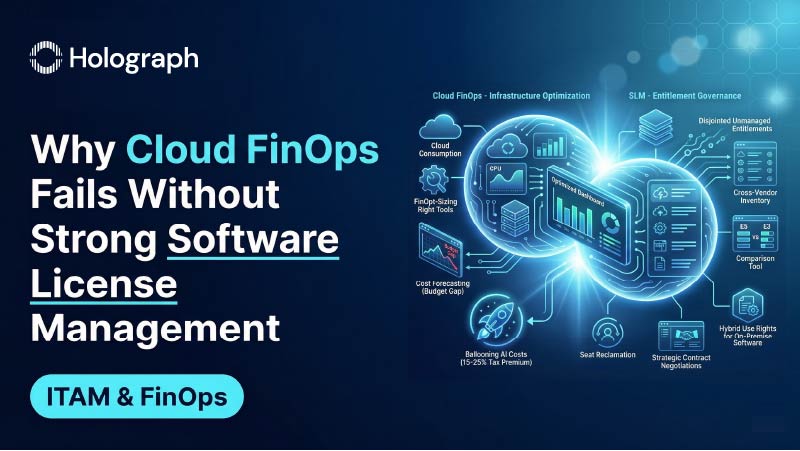
The software license management FinOps relationship is not competitive. It is complementary. Each discipline covers territory the other does not, and the combined approach captures the full optimization opportunity.
Software license management brings four capabilities that FinOps lacks.
Cross-vendor license inventory. A unified view of every software entitlement the organization holds, across every vendor, every agreement type, and every deployment model. This is the discovery layer that FinOps assumes someone else is providing.
Tier optimization and seat reclamation. Analyzing user-level consumption patterns to right-size subscription tiers and reclaim licenses from inactive users. This is the SaaS equivalent of right-sizing cloud instances, but it requires vendor-specific pricing knowledge and license management tooling rather than cloud cost platforms.
Vendor negotiation and renewal management. Approaching enterprise agreements as strategic negotiations rather than administrative renewals. At Holograph, our multi-OEM partnerships across Atlassian, Microsoft, Adobe, AWS, Google, and GitLab give us negotiation context that individual enterprises cannot replicate, because we see pricing patterns across 170+ engagements rather than a single contract.
Compliance management. Maintaining ongoing entitlement-to-deployment reconciliation that prevents both over-licensing (cost waste) and under-licensing (audit risk). The organizations that manage this continuously spend a fraction of what those caught in reactive audit remediation spend. According to Gartner, integrating ITAM with FinOps is now a top recommendation for CIOs seeking to control software, cloud, and AI costs simultaneously, precisely because the compliance and optimization data need to flow through the same governance layer.
When You Need Both: A Decision Framework
Not every enterprise needs the same software license management FinOps combination. The right approach depends on the complexity and composition of your technology portfolio.
FinOps alone may suffice if your organization runs primarily on public cloud infrastructure with minimal SaaS subscriptions, no significant on-premises estate, and fewer than three major software vendors. This profile is increasingly rare among enterprises with 500+ employees, but it exists.
Software license management alone may suffice if your organization runs primarily on-premises or in a private cloud with minimal public cloud consumption. The optimization opportunity lives in vendor contracts, renewal terms, and license tier alignment rather than in cloud resource utilization.
Both disciplines together make sense for the majority of enterprises running hybrid environments with multiple cloud providers, multiple SaaS vendors, and some remaining on-premises infrastructure. This is the profile of most organizations spending more than $2 million annually on software. The FinOps practice handles cloud consumption optimization; the software license management practice handles everything else; and a governance layer connects the two to ensure nothing falls through the gap.
The FinOps Foundation itself recognized this convergence. Its 2025 Framework update added "Scopes" as a core element, expanding the discipline's coverage from public cloud to SaaS, licensing, and data centers. The updated mission statement shifted from "Advancing the People who manage the Value of Cloud" to "Advancing the People who manage the Value of Technology." The direction is clear. But for most enterprises, the gap between aspiration and practice remains wide.
Deep dive: Software License Management vs SAM vs FinOps: Choosing the Right Approach
Closing: The Combined Approach
The 30% overspend figure that persists across enterprise software portfolios is not a FinOps failure. It is a scope problem. FinOps optimizes what it was designed to optimize — cloud infrastructure consumption — and it does that well. The remaining waste sits in SaaS subscriptions, on-premises entitlements, uncontested renewals, and ungoverned departmental purchases that fall outside the FinOps lens.
Improving software licensing management across the full technology stack requires connecting cloud cost optimization with vendor-level license management and contract negotiation. At Holograph, our experience across 170+ enterprise engagements shows that the combined approach — FinOps for cloud consumption, structured license management for everything else — is where the full savings opportunity lives.
The organizations that close the gap are the ones that treat software license management FinOps convergence not as a future aspiration but as a present-day operating requirement, building the governance structures that connect both disciplines into a single cost management strategy.
Related Reading
This blog is part of Holograph's Software Licensing Management content series. For a comprehensive overview of enterprise license management, read the complete pillar guide. To assess where your organization stands, take the License Waste Self-Assessment.