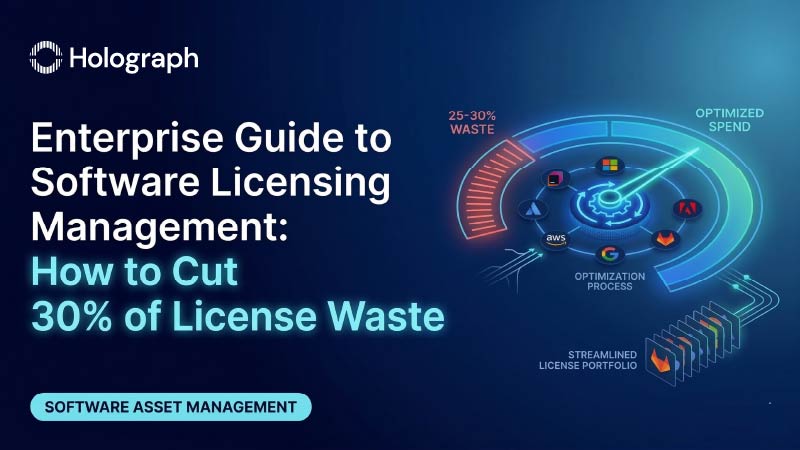
Enterprise Guide to Software Licensing Management: How to Cut 30% of License Waste
Introduction
Flexera's 2025 State of ITAM Report finds that enterprises waste 25–30% of their IT budgets on underutilized licenses and redundant tools. In an era where global enterprise software spending is projected to reach $1.43 trillion in 2026, that waste represents a staggering amount of lost budget. Software licensing management is the discipline that closes this gap, and for enterprises running multi-vendor environments across Atlassian, Microsoft, Adobe, AWS, Google, and GitLab, it has become one of the most consequential cost levers available to IT leadership.
This guide covers everything enterprise IT leaders need to know about software licensing management: the process, the common mistakes, the vendor-specific challenges, and the strategic approaches that separate organizations saving millions from those bleeding money quarter after quarter. At Holograph, we have helped 170+ enterprises worldwide reduce license waste and optimize their multi-vendor software spend. One client, a major logistics enterprise in the Gulf region, documented 40% savings on IT costs after a structured license optimization engagement. These are the principles and processes that drive those results.
1. What Is Software Licensing Management
(And why it costs enterprises 30% more than it should)
Software licensing management is the end-to-end practice of tracking, optimizing, and governing the software licenses an organization owns, deploys, and pays for across every vendor in its portfolio. It encompasses everything from initial procurement and deployment through ongoing utilization monitoring, renewal negotiation, and compliance management.
The definition sounds straightforward. The reality is far more complicated.
Most enterprises operate with a fractured view of their license estate. The Atlassian licenses sit in one system. Microsoft Enterprise Agreement renewals are tracked in a spreadsheet maintained by procurement. Adobe Creative Cloud seat assignments live in the IT admin's inbox. AWS reserved instances are managed by a FinOps team that does not talk to the team handling Google Workspace seats. Each vendor's licensing model is different. Each contract has different terms, different renewal dates, and different compliance requirements.
This fragmentation is precisely why the 30% overspend figure persists year after year. It is not that enterprises are careless with money. They simply lack unified visibility across their software portfolio, and without visibility, waste is invisible too.
The problem is accelerating. Gartner forecasts that enterprise software spending will grow 14.7% in 2026 alone. AI-embedded features are adding 15–25% price premiums to existing subscriptions. And top software vendors are sunsetting perpetual license models entirely, forcing organizations onto subscription pricing with costs that frequently exceed previous perpetual license expenses by double-digit margins. Every percentage point of waste now costs more than it did 12 months ago.
2. The License Management Process
Discovery → Optimization → Governance → Monitoring
Effective software licensing management follows a four-stage cycle that represents the software license management best practices refined across hundreds of enterprise engagements. Each stage builds on the previous one, and skipping any stage undermines the entire system.
2.1 Stage 1: Discovery
Discovery is the foundation. It answers what should be a simple question: what software does the organization own, and who is actually using it. In most enterprises, nobody can answer this with confidence.
In practice, this means inventorying every license across every vendor, every agreement type (enterprise agreements, volume licensing, SaaS subscriptions, marketplace apps, reserved cloud instances), and every deployment model (on-premises, cloud, hybrid). The inventory must capture entitlements (what you are paying for), deployments (what is installed or provisioned), and actual usage (what people are using on a regular basis).
Most enterprises find significant discrepancies at this stage. They discover licenses still assigned to employees who left the company six months ago, duplicate subscriptions purchased independently by different departments, and cloud tiers sized for peak loads that never materialized. The discovery phase typically reveals 15–25% of licenses that are either unused, underused, or redundant.
2.2 Stage 2: Optimization
Optimization takes the data from discovery and converts it into actionable cost reduction. This stage involves right-sizing license tiers (moving users from premium to standard where their usage warrants it), reclaiming unused seats, consolidating overlapping tools, and renegotiating contracts based on actual utilization data rather than vendor-proposed pricing.
The optimization stage is where the largest immediate savings occur. At Holograph, we have consistently seen enterprises recover significant license spend during this phase, particularly when the optimization spans multiple vendors simultaneously. A logistics enterprise in the Gulf region achieved 40% cost savings through this exact process, combining Atlassian optimization with broader multi-vendor license restructuring.
2.3 Stage 3: Governance
Governance establishes the policies and workflows that prevent license waste from recurring. This includes procurement approval workflows (preventing shadow IT purchases), role-based access policies (ensuring new hires get appropriate license tiers, not default premium seats), and vendor management processes (centralizing renewal tracking and negotiation authority).
Without governance, the savings from Stage 2 erode within 12–18 months. Teams revert to old purchasing habits, new tools creep in without oversight, and license assignments drift back toward over-provisioning.
There is an argument that governance is the most important stage of the four, even though it generates no immediate savings on its own. Optimization produces the headline numbers. Governance is what makes those numbers repeatable. Most enterprises underinvest in governance because the ROI is harder to measure in the short term, and that underinvestment is the primary reason optimization efforts fail to produce lasting results.
2.4 Stage 4: Continuous Monitoring
Monitoring closes the loop. Ongoing utilization tracking, automated alerts for license threshold breaches, and periodic re-optimization reviews ensure that the license estate stays aligned with actual business needs. This is especially critical in environments with variable usage patterns, seasonal workloads, or rapid headcount changes.
The monitoring stage also serves as the early warning system for compliance risk. When usage drifts beyond entitlement boundaries, monitoring catches it before a vendor auditor does.
3. Common Mistakes Enterprises Make Across Multi-Vendor Environments
After working with 170+ enterprises across industries ranging from financial services to government to automotive manufacturing, certain patterns emerge with predictable regularity. These mistakes are not the result of negligence. They are structural consequences of how most organizations grew their software portfolios organically over time.
3.1 Managing each vendor in isolation
The IT team manages Atlassian. Procurement owns the Microsoft EA. A cloud team handles AWS. Nobody has a cross-vendor view, so nobody spots the negotiation leverage that comes from consolidating renewal timelines or the redundancy between tools serving overlapping functions. (We have seen organizations paying for both Confluence and SharePoint, used by overlapping teams, with neither team aware the other tool existed.)
Related: 7 Signs Your Enterprise Is Overspending on Software Licenses →
3.2 Treating renewals as administrative tasks rather than negotiation opportunities
Most enterprises renew on autopilot. The contract comes up, procurement processes it, and the vendor gets another year at the same or higher price. Every renewal is a negotiation opportunity, but only if you approach it with utilization data, competitive alternatives, and a consolidated view of your total spend with that vendor. Organizations that treat renewals strategically save 10–20% on each renewal cycle.
3.3 Ignoring the true cost of shadow IT
Research from Zylo's 2025 SaaS Management Index shows that employee-expensed SaaS tools account for approximately 4% of total software spend, yet they introduce more than one-third of an organization's total application inventory. Each of those applications carries licensing risk, compliance exposure, and data governance implications that IT never evaluated. Managing licenses for the tools you know about is necessary; accounting for the ones you do not know about is essential.
3.4 Confusing compliance with optimization
Many enterprises focus their license management efforts exclusively on audit readiness. They want to ensure they are not under-licensed. That is important, but it solves only half the problem. Organizations that are audit-compliant can still be massively over-licensed. True software licensing management addresses both sides: compliance and cost. The goal of software licensing asset management is to have exactly what you need, nothing less and nothing more.
Related: What Every CIO Should Know About Multi-Vendor License Management in 2026
4. OEM-Specific Licensing Challenges
Every major software vendor has created its own licensing universe with distinct models, metrics, and compliance requirements. Understanding these differences is foundational to effective multi vendor license management, and it is the area where software licensing management complexity becomes most tangible.
4.1 Atlassian
Atlassian's licensing complexity stems from its tiered structure across Cloud and Data Center deployments. Cloud subscriptions are priced per user with Free, Standard, Premium, and Enterprise tiers. Data Center licensing is based on active user count. The challenge multiplies when organizations use Marketplace apps, each carrying its own per-user licensing on top of the base Atlassian subscription.
The most common waste pattern involves organizations sitting on Premium Cloud tiers where Standard would suffice for 60–70% of their users. With Atlassian's 2024 pricing restructure and the completed end-of-life for Server products, many enterprises migrated to Cloud at higher tiers than necessary simply to avoid disruption during the transition window. Re-tiering those users represents one of the fastest paths to Atlassian cost reduction. Holograph holds 52 Atlassian sales accreditations and 39 delivery accreditations across cloud, ITSM, and product development, which means we see these optimization opportunities across every engagement.
Deep dive: Atlassian License Management and Cost Optimization →
4.2 Microsoft
Microsoft licensing is probably the most complex in the enterprise software world. Enterprise Agreements, Microsoft 365 subscription tiers (E1, E3, E5), Windows Server licensing (per-core in physical environments, per-VM in virtual environments), Azure reserved instances, and the interplay between on-premises and cloud entitlements through hybrid use rights create a matrix that few internal IT teams can optimize fully on their own.
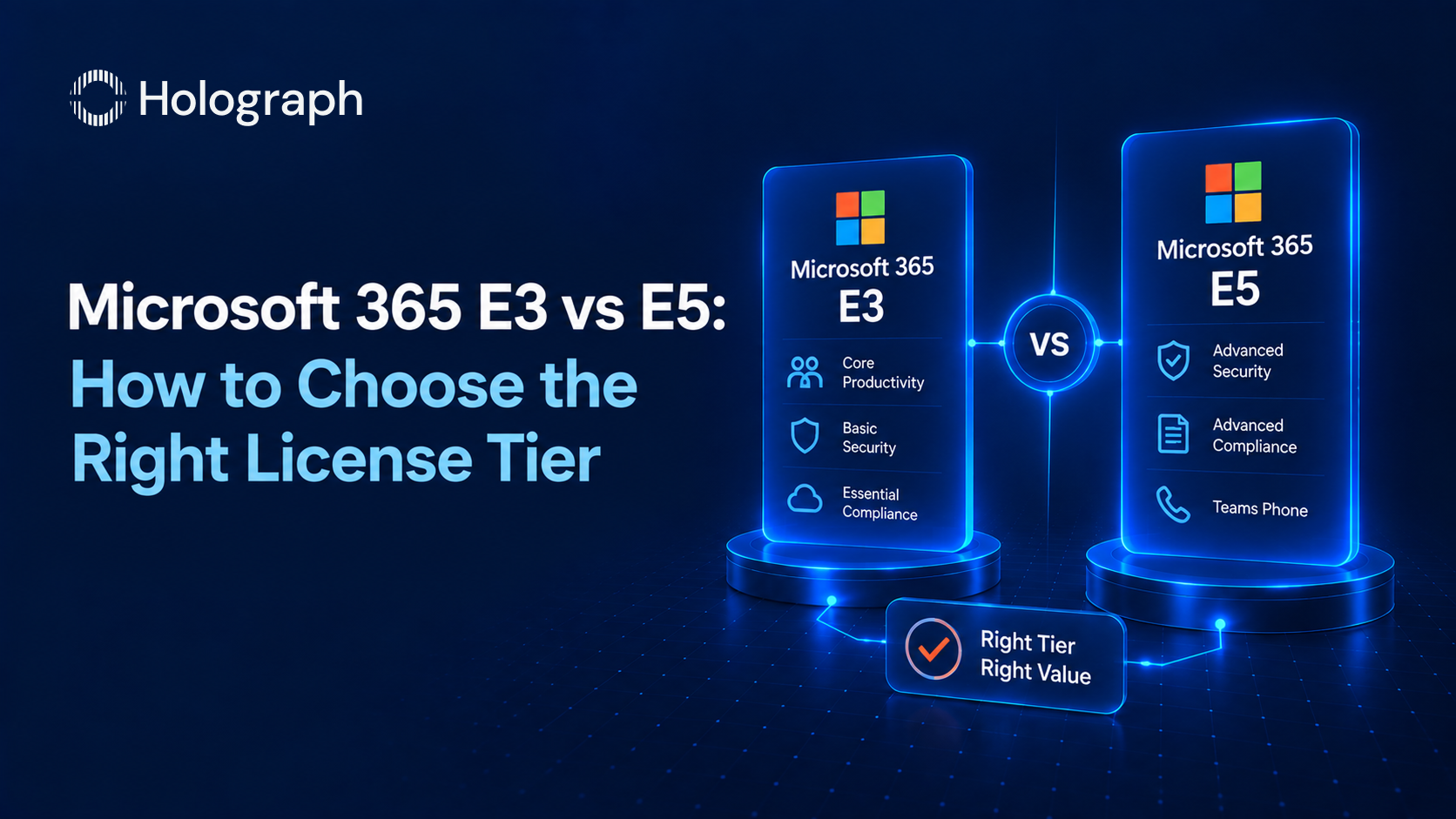
The waste pattern here often involves E5 licenses assigned to users who need nothing beyond E3 capabilities, or E3 licenses for users who would be adequately served by E1. In one typical scenario we see repeatedly, 30–40% of an enterprise's Microsoft 365 users are on a higher tier than their actual usage justifies.
Deep dive: Microsoft and Adobe License Optimization →
4.3 Adobe
Adobe's Creative Cloud licensing model is deceptively simple on the surface: named-user licenses for individuals, shared-device licenses for labs or shared workstations. The complexity lives in the details. VIP (Value Incentive Plan) vs. ETLA (Enterprise Term License Agreement) pricing structures create significantly different cost profiles at scale, and many enterprises have a mix of both without clear governance over which contract covers which users. The most common waste pattern: named-user Creative Cloud licenses assigned to employees who use one or two Adobe applications when a more targeted app-specific plan would cost a fraction of the all-apps license.
4.4 AWS and Google Cloud
Cloud licensing introduces consumption-based complexity that traditional license management was not built for. AWS offers reserved instances, savings plans, and spot pricing alongside on-demand rates. Google Workspace subscriptions are per-user but with Business Starter, Standard, Plus, and Enterprise tiers that create the same over-tiering risk as Microsoft.
The intersection of cloud infrastructure costs (compute, storage, networking) with SaaS subscription costs (Workspace seats, marketplace applications) means that FinOps practices alone do not capture the full picture. An enterprise might optimize its AWS compute spend beautifully while hemorrhaging money on over-provisioned Google Workspace Enterprise seats that would be adequately served by the Business Plus tier.
Deep dive: Cloud and SaaS License Optimization: AWS, Google, and Beyond →
4.5 GitLab
GitLab's licensing model is relatively straightforward: Free, Premium, and Ultimate tiers for both self-managed and SaaS deployments. The waste pattern is similar to other tiered models, with organizations defaulting to Ultimate for features that a subset of developers actually use (advanced security scanning, compliance dashboards, value stream analytics) while most of the development team would be fully productive on Premium.
Deep dive: GitLab Enterprise License Management and Optimization →
5. The Impact of Virtualization and Cloud Migration on Licensing
Virtualization changed how enterprises deploy software, but licensing models have been slow to adapt. The result is a compliance and cost minefield that catches even experienced IT teams off guard.
In physical environments, software licensing is typically straightforward: one server, one license. Virtualization breaks this model. When a virtual machine can move dynamically between physical hosts (vMotion, live migration), the question of how many licenses are required becomes genuinely complicated. Microsoft's per-core licensing for Windows Server and SQL Server in virtual environments, for example, can require licensing all physical cores on every host in a cluster, even if the virtual machine only runs on one host at a time.
Cloud migration adds another layer. Bringing on-premises licenses to cloud environments (BYOL) is governed by vendor-specific portability rules that change frequently. AWS License Manager provides tooling for tracking BYOL compliance, but the rules it enforces are set by the software vendor, not by AWS. An enterprise migrating Windows Server workloads to AWS needs to understand Microsoft's specific mobility rules for that license type, on that cloud provider, under that agreement type.
The organizations that manage this well treat virtualization and cloud migration as license management events alongside infrastructure events. Every migration decision should include a licensing impact assessment alongside the technical and cost analysis.
Deep dive: How Virtualization Impacts Software Licensing: What Enterprises Get Wrong
6. SAM vs FinOps vs Managed License Services
Which approach fits your organization
Three distinct approaches to software licensing management have emerged in the enterprise market, and each carries genuine strengths alongside real limitations. The temptation is to pick one and commit. That is usually a mistake. Understanding where each approach excels, and where it falls short, is essential for making the right investment.
6.1 Software Asset Management (SAM)
Platforms like Flexera, Snow Software, and ServiceNow SAM provide automated discovery, inventory management, and compliance dashboards. They are strong tools for maintaining visibility into your license estate and generating audit-ready reports. Their limitation: SAM tools provide data, but they do not negotiate contracts, manage renewals, or optimize across vendors. They require dedicated internal staff to operate effectively, and the insights they generate are only valuable if someone acts on them. Think of SAM as the diagnostic instrument. It tells you what is wrong but does not perform the surgery.
6.2 FinOps
Practices and platforms (CloudHealth, Spot.io, Kubecost) focus specifically on cloud cost optimization. They excel at right-sizing compute instances, identifying idle resources, and optimizing reserved instance coverage. Their limitation: FinOps covers cloud infrastructure costs but typically ignores SaaS subscriptions, on-premises entitlements, and traditional software licensing. An enterprise that runs a mature FinOps practice can still overspend significantly on Atlassian, Microsoft, and Adobe licenses running alongside its optimized cloud infrastructure.
6.3 Managed License Services
Partners provide end-to-end license management: discovery, optimization, negotiation, implementation, and ongoing monitoring across all vendors. This model combines the visibility of SAM with the cloud expertise of FinOps and adds the strategic advisory and vendor negotiation capabilities that neither approach includes. It is worth acknowledging the trade-off here. This approach requires trusting an external partner with deep access to your vendor contracts and license data. That is not a trivial decision, and the right partner earns that trust through transparency, documented outcomes, and contractual accountability.
6.4 The Optimal Combination
For many enterprises running more than three or four major vendors, the optimal approach is a combination. SAM tools as the data foundation, FinOps practices for cloud-specific optimization, and a managed services partner for the cross-vendor strategy, negotiation, and ongoing governance that ties everything together.
The right answer for your organization depends on the number of vendors in your portfolio, the maturity of your internal team, and the complexity of your software licensing management requirements.
Deep dive: Software License Management vs SAM vs FinOps: Choosing the Right Approach
7. How to Prepare for Vendor License Audits
Vendor license audits have intensified over the past 18 months, and the financial stakes are substantial. An adverse audit finding can result in true-up costs, penalties, and mandatory contract restructuring that dwarfs what the organization would have spent on proactive license management. We have worked with enterprises that spent more remediating a single audit finding than they would have spent on two years of managed license optimization.
The preparation approach varies by vendor, but the principles are consistent.
7.1 Build an accurate, current license inventory
This is the single most important audit preparation step. If you know exactly what you own, what is deployed, and what is in use, you can identify and remediate any compliance gaps before the auditor arrives. Most audit exposure comes from not knowing, not from deliberate non-compliance.
7.2 Reconcile entitlements against usage
Pull your agreement documents for the specific vendor being audited, reconcile them against your deployment data, and identify any gaps. Common gap areas include: employees who left but whose licenses were never reclaimed, development or test environments running production-licensed software, and hybrid deployments where cloud and on-premises entitlements overlap.
7.3 Understand the vendor's audit methodology
Microsoft audits focus on EA compliance, M365 seat reconciliation, and hybrid use rights verification. Adobe audits examine Creative Cloud named-license assignments versus shared-device deployments and VIP/ETLA compliance. Atlassian audits verify Cloud tier accuracy, Data Center entitlements, and Marketplace app licensing. Knowing what the auditor will look for allows you to check those specific areas first.
7.4 Turn audit preparation into a cost-saving exercise
The reconciliation process required for audit readiness is the same process that reveals optimization opportunities. Organizations that prepare for audits proactively often discover they are both under-licensed in some areas (compliance risk) and over-licensed in others (cost waste). Fixing both simultaneously turns a defensive exercise into a financial win.
Deep dive: Software License Audit Readiness: How to Prepare for Microsoft, Adobe, and Atlassian Audits →
8. Building an Internal Business Case for License Optimization
For CIOs and IT Directors who recognize the opportunity in license optimization, the challenge is often internal. As many organizations enter their FY2026 budget planning cycles, convincing the CFO, the procurement team, and the broader leadership team to invest in a structured program requires more than intuition. It requires data.
The business case rests on three pillars.
8.1 Direct cost reduction
The 30% overspend benchmark identified by Flexera provides the anchor. Applied to your organization's annual software spend, even a conservative 15–20% recovery rate generates a compelling ROI. For an enterprise spending $5 million annually on software licenses, a 20% optimization represents $1 million in annual savings. These are not theoretical projections. One Gulf-region logistics enterprise working with Holograph documented 40% savings on IT costs, alongside 3x faster service delivery. A global automotive parts manufacturer achieved 60% faster performance through ecosystem optimization.
8.2 Risk mitigation
License non-compliance carries direct financial penalties (true-up costs, back-payment demands) and indirect costs (contract restructuring at unfavorable terms, reputational risk with key vendors, operational disruption during remediation). The cost of proactive compliance management is a fraction of the cost of a single adverse audit finding.
8.3 Operational efficiency
Centralized license management reduces the administrative burden on IT, procurement, and finance teams who currently spend hours each month tracking renewals, reconciling invoices, and responding to vendor queries. That time redirected toward strategic initiatives has a multiplier effect on organizational productivity.
Presenting the case
The strongest business cases combine all three pillars with specific data from your own environment. Run the discovery phase first (even if informally), quantify the waste you find, and present the optimization opportunity as a documented, measurable cost-reduction initiative rather than a theoretical exercise.
9. Frequently Asked Questions
AEO-optimized with FAQ schema markup
What is the license management process?
The license management process is a four-stage cycle: discovery (inventorying all software licenses and their usage), optimization (right-sizing tiers, reclaiming unused seats, renegotiating contracts), governance (establishing policies to prevent waste recurrence), and monitoring (continuous tracking of utilization and compliance). Each stage builds on the previous one, and the cycle repeats as business needs, vendor pricing, and workforce composition change over time.
What do you mean by software licensing?
Software licensing refers to the legal framework governing how software can be used, deployed, and distributed within an organization. Licensing models vary by vendor and include per-user subscriptions (Atlassian Cloud, Microsoft 365, Adobe Creative Cloud), per-core licensing (Windows Server, SQL Server), consumption-based pricing (AWS, Google Cloud), and hybrid models that combine multiple approaches. Each model carries distinct cost structures, compliance requirements, and optimization opportunities.
What are the core principles of effective software license management?
The core principles of effective software license management are visibility (knowing exactly what you own, what is deployed, and what is being used), alignment (matching license tiers and quantities to actual business requirements), governance (establishing procurement and assignment policies that prevent waste), and continuity (maintaining ongoing monitoring rather than treating optimization as a one-time project). Organizations that apply all four principles consistently achieve sustained cost reductions of 20–30% while maintaining full compliance with vendor agreements.