Consolidating License Renewals to One Anniversary Date: Benefits and Playbook
Key Takeaways
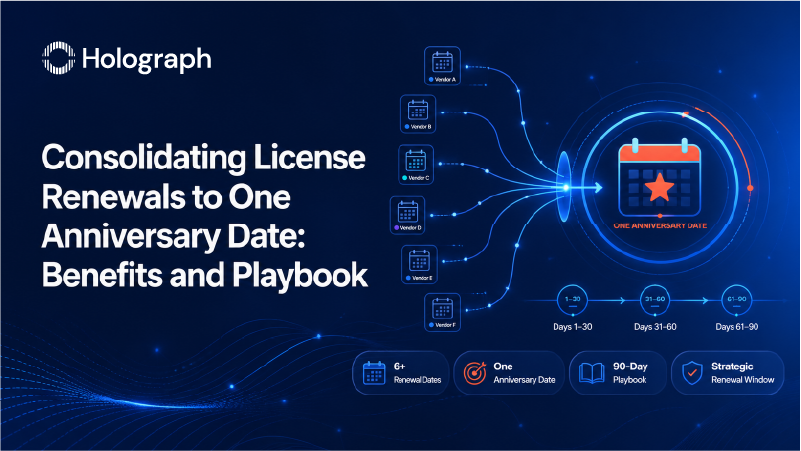
- Enterprises managing six or more vendor renewal dates throughout the year lose negotiation leverage, budget predictability, and administrative efficiency with every isolated renewal.
- Co-terminating license agreements to a single anniversary date enables cross-vendor negotiation, portfolio-level budget planning, and a single annual window for strategic software decisions.
- The process to consolidate license renewals follows a 90-day playbook: inventory and timeline mapping (Days 1–30), vendor outreach and alignment negotiations (Days 31–60), and execution with contractual safeguards (Days 61–90).
- Forrester research confirms that contract lifecycle management has become a strategic function, not an administrative one, with leading enterprises treating renewal windows as decision points for portfolio optimization.
Introduction
The decision to consolidate license renewals is one that most enterprises arrive at after years of managing the alternative. The fragmentation happens organically. The Microsoft EA was signed in Q1 three years ago. The Atlassian Cloud subscription started when the team migrated from Server in Q3. The Adobe ETLA landed in the procurement queue during a Q4 budget flush. AWS reserved instances were purchased opportunistically across quarters as workloads shifted. Each agreement carries its own anniversary date, and nobody consolidated them after the fact.
The financial consequence of this fragmentation is real. When you renew each vendor independently, you negotiate each vendor independently. There is no portfolio-level leverage, no ability to compare total spend across vendors in a single decision window, and no opportunity to align software investment with the annual budget cycle. The result is a procurement process that operates in perpetual reactive mode, processing renewals as they arrive rather than managing the software portfolio as a strategic asset.
The decision to consolidate license renewals to a single anniversary date changes this dynamic. It is not a trivial exercise, and it requires vendor cooperation, short-term contract adjustments, and careful planning. But the enterprises that complete it consistently report 10–20% better renewal terms, significantly reduced administrative overhead, and a level of budget predictability that scattered renewals can never provide.
The Case for Co-Termination
Co-termination means aligning multiple vendor agreements so that they share a single renewal date. The benefits fall into three categories, and each compounds over time.
Negotiation leverage
This is the most financially significant reason to consolidate license renewals. When an enterprise approaches all vendor renewals simultaneously, with a complete picture of total software spend and utilization data across the portfolio, the negotiation dynamics change fundamentally. You can evaluate trade-offs between vendors (should this budget go toward an Atlassian tier upgrade or a Microsoft E5 expansion?), reference competitive alternatives with credibility (if Adobe's renewal terms are unfavorable, the budget can be redirected), and present each vendor with the context of their pricing relative to the rest of the portfolio.
Isolated renewals eliminate this leverage entirely. When the Microsoft renewal comes up in March and the Atlassian renewal does not arrive until July, the Microsoft negotiation cannot reference the Atlassian budget as a lever, and vice versa. The vendors negotiate against your inertia rather than against each other.
Industry analysis from Redress Compliance recommends beginning renewal preparation 8–12 months before expiration, specifically because early preparation with utilization data is what creates the conditions for favorable terms. Co-termination compresses this preparation into a single focused period rather than spreading it across the calendar year.
Budget predictability
CFOs and IT finance teams operate on annual budget cycles. When software renewals are scattered across 12 months, the budget impact of each renewal is a surprise that requires mid-cycle adjustment. Co-terminating all renewals to a single date aligns the software portfolio with the annual planning process. Total software cost is known, approved, and allocated as a single budget line during the planning cycle, eliminating the mid-year surprises that make IT budgets feel unpredictable to finance teams.
Administrative efficiency
Every renewal requires a preparation sequence: pulling utilization data, reviewing contract terms, engaging stakeholders, conducting the negotiation, processing the purchase order, and updating the license inventory. When this sequence runs six or more times per year across different vendors, it consumes significant procurement and IT time. Consolidating renewals compresses this overhead into a single annual window, freeing those teams for strategic work during the remaining months.
How Co-Termination Works
Understanding how to consolidate license renewals in practice requires familiarity with three common alignment mechanisms. The mechanics vary by vendor, but the approach follows a consistent pattern.
Short-term extensions
The most common alignment method. If the target anniversary date is July 1 and the Microsoft EA currently expires in March, Microsoft can extend the current agreement by four months (with prorated fees) so that the next renewal cycle begins on July 1. Most enterprise vendors accommodate extension requests, particularly when the request is framed as part of a longer-term commitment.
Early renewals with prorated credits
Some vendors offer the option to renew early, with the remaining months of the current agreement credited toward the new term. This works well when the target anniversary date falls before the current expiration. The key is ensuring the prorated calculation is fair and that the early renewal does not trigger unfavorable pricing resets.
Contract restructuring at renewal
For agreements approaching their natural expiration, the simplest path is negotiating the new term to begin on the target anniversary date rather than the day after the current agreement ends. This may involve a short gap (covered by month-to-month extensions) or an overlapping period (covered by prorated adjustments). The negotiation of these transitional arrangements is itself a leverage opportunity, because the vendor's desire to secure the renewal creates room for concessions.
Vendor-by-Vendor Considerations
Not every vendor makes co-termination equally straightforward. Understanding the differences before starting the consolidation process avoids surprises mid-execution.
Microsoft Enterprise Agreements have historically supported co-termination well, with extension and early renewal options built into the agreement structure. However, Microsoft's transition from EA to MCA-E frameworks has introduced new complexity. The MCA-E model removes the annual true-up mechanism, and organizations transitioning between agreement types need to account for the structural differences when planning co-termination timing. Working with a licensing advisor during this transition is particularly valuable given the 10–30% cost increases that organizations without structured negotiation support have absorbed.
Atlassian Cloud subscriptions operate on straightforward annual terms that can be adjusted at renewal. Co-termination with Atlassian is typically the simplest vendor to align because the subscription model is flexible and Atlassian's commercial team accommodates timing adjustments without penalty. Data Center agreements follow a similar pattern, though the user-band licensing model requires careful tier planning when adjusting term dates.
Adobe VIP agreements have historically been less flexible on timing adjustments than Enterprise Term License Agreements (ETLA). VIP anniversaries are set at the account level, and changing them may require transitioning between VIP and ETLA structures or working through an authorized reseller to restructure the account. ETLA terms are more negotiable, particularly for organizations with large seat counts.
AWS and Google Cloud present a different challenge because their primary cost model is consumption-based rather than contract-based. Reserved instance commitments and savings plans do carry term dates, and these can be aligned with other vendor renewals. However, the on-demand component of cloud spend does not follow a renewal cycle, which means co-termination applies to the committed-spend portion only.
Related: Atlassian License Management and Cost Optimization →
Related: Microsoft and Adobe License Optimization →
The 90-Day Playbook
The process to consolidate license renewals follows a structured 90-day timeline that works regardless of portfolio size or vendor mix.
Days 1–30: Inventory and timeline mapping
Build a complete inventory of every software agreement, including vendor name, agreement type, current expiration date, annual cost, primary business owner, and renewal terms (auto-renewal clauses, notice periods, early termination provisions). Map all expiration dates on a single timeline to identify the optimal target anniversary date. The best target date typically falls 2–3 months after the fiscal year begins, giving finance teams time to finalize budgets before the renewal window opens.
Days 31–60: Vendor outreach and alignment negotiations
Contact each vendor's account team to discuss co-termination. Present the business case: you are consolidating your renewal cycle to improve portfolio governance, and you are asking for their cooperation in adjusting the term dates. Most vendors respond positively because co-termination signals a committed, long-term customer relationship. Negotiate the extension, early renewal, or restructuring terms for each agreement, documenting any prorated fees, credits, or transitional arrangements.
Days 61–90: Execution and contractual safeguards
Execute the contractual amendments, process the transitional payments or credits, and update the license inventory to reflect the new unified anniversary date. Build contractual safeguards into every amended agreement: true-down rights (the ability to reduce license counts at renewal, not just increase them), uplift caps (limiting annual price increases to a defined percentage, typically 3–5% according to industry benchmarks), and notice period alignment (ensuring you have adequate time before the unified anniversary date to conduct utilization reviews and prepare negotiation positions).
Risk Mitigation
Co-termination involves contractual changes, and contractual changes carry risk. Three areas require specific attention.
Early termination fees. Some agreements impose penalties for terminating before the contracted end date. Review every agreement for termination clauses before proposing co-termination. In most cases, the vendor will waive these fees as part of the co-termination negotiation, particularly if the new consolidated agreement represents equal or greater committed spend.
Proration disputes. When extending or shortening agreement terms, the calculation of prorated fees can become a point of contention. Document the proration methodology in writing before executing any amendment, and verify the calculation against actual usage to ensure accuracy.
Auto-renewal traps. Many enterprise agreements contain auto-renewal clauses with 60–90 day notice periods. If the co-termination process extends past a notice deadline, you may find yourself locked into another year on the old terms. Map every notice period in the Day 1–30 inventory phase and set calendar alerts for each one.
When to Bring in a Partner
The effort to consolidate license renewals is manageable internally when the portfolio includes two or three vendors with straightforward agreement structures. It becomes significantly more complex with four or more vendors, mixed agreement types (EA, ETLA, VIP, cloud subscriptions, reserved instances), and cross-regional licensing structures.
The complexity threshold is where a partner like Holograph delivers disproportionate value. Our multi-OEM partnerships across Atlassian, Microsoft, Adobe, AWS, Google, and GitLab mean we negotiate with these vendors daily across 170+ enterprise engagements. We know the flexibility each vendor offers, the concessions that are achievable, and the transitional arrangements that work without creating unintended compliance gaps. That cross-vendor negotiation intelligence is what turns a 90-day consolidation process from a project into a repeatable capability.
The organizations that consolidate license renewals successfully share one characteristic: they treat the renewal window not as an administrative obligation but as an annual strategic decision about their software investment. Everything else follows from that shift in perspective.
Related Reading
- Enterprise Guide to Software Licensing Management: How to Cut 30% of License Waste (Pillar page)
- 7 Signs Your Enterprise Is Overspending on Software Licenses (Sign 2 links here)
- Atlassian License Management and Cost Optimization
- Microsoft and Adobe License Optimization
This blog is part of Holograph's Software Licensing Management content series. For a comprehensive overview of enterprise license management, read the complete pillar guide. To discuss your renewal consolidation strategy, request a license strategy consultation.