How to Prepare for a Multi-Vendor License Audit and Reduce Spend in the Process
Key Takeaways
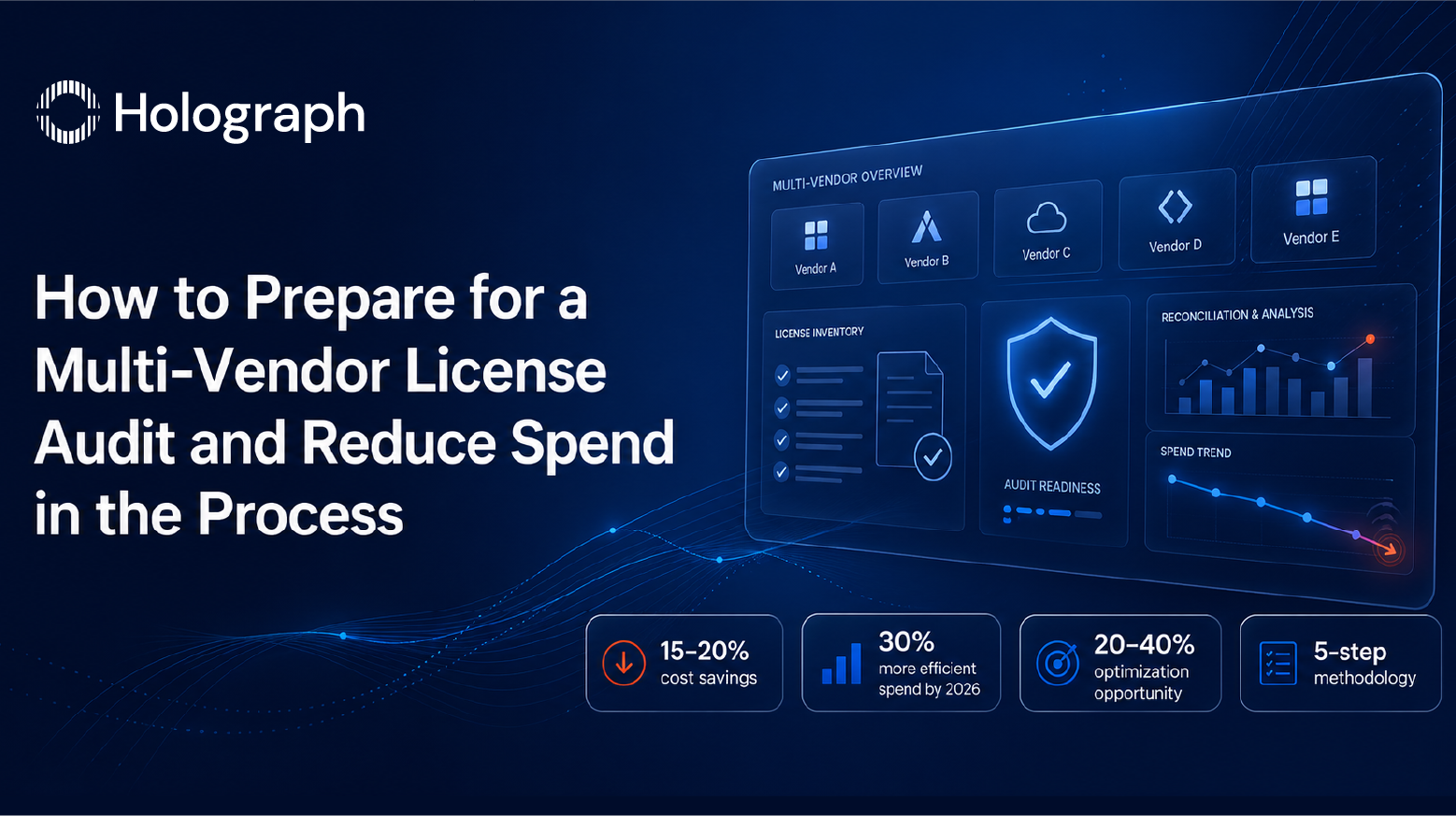
- A multi-vendor license audit is no longer an occasional inconvenience. It is a recurring financial event that demands a structured preparation methodology.
- Gartner research indicates that organizations implementing ITAM best practices achieve 15–20% cost savings, and those that reposition software asset management from centralized execution to strategic governance can expect 30% more efficient software spend by 2026.
- The same reconciliation process that prepares an enterprise for a multi-vendor license audit simultaneously reveals cost optimization opportunities worth 20–40% of annual license spend.
- Holograph's five-step methodology transforms audit preparation from a defensive scramble into a proactive cost-recovery initiative.
Introduction
The era of single-vendor audits is fading. Enterprises running portfolios that span Microsoft, Adobe, Atlassian, AWS, Google, and GitLab increasingly face overlapping audit timelines where compliance gaps in one vendor relationship compound exposure across others. The financial stakes have risen in parallel. According to SAMexpert, organizations that transition between licensing models without structured negotiation routinely absorb 10–30% cost increases, and Microsoft's shift from Enterprise Agreements to MCA-E frameworks is making audit preparation more complex, not less.
A multi-vendor license audit preparation process that addresses all vendors simultaneously, rather than treating each audit as an isolated event, fundamentally changes the economics. The reconciliation required for compliance readiness is identical to the reconciliation that reveals over-licensing, redundant subscriptions, and tier misalignment. The organizations that understand this do not fear audits. They use the preparation process as a scheduled opportunity to recover costs.
At Holograph, our work with 170+ enterprises across six major OEMs has refined a five-step methodology that turns multi-vendor license audit preparation into a structured cost-recovery initiative. The steps are consistent. The savings are repeatable. This playbook walks through each stage.
Step 1: Build a Unified License Inventory Across All Vendors
The first step in any multi-vendor license audit preparation process is the one that most enterprises skip: building a single, cross-vendor inventory that captures every entitlement, every deployment, and every active user across the entire software portfolio.
The reason this step is skipped is understandable. Most organizations manage each vendor's licenses in a different system, maintained by a different team, with different data structures and update cadences. The Microsoft licenses live in procurement's spreadsheet. Atlassian subscriptions are tracked in the IT admin console. Adobe ETLA records sit in a shared drive that the original procurement manager created before leaving the company. AWS and Google Cloud are managed by a FinOps team that uses a different cost allocation framework entirely.
The result is a fragmented picture that no single person or team can see in its entirety. And fragmentation is what auditors exploit, because gaps between systems are where compliance discrepancies hide.
The unified inventory must capture three data layers for every vendor: entitlements (what you are licensed to use, including agreement type, tier, quantity, and renewal date), deployments (what is actually installed, provisioned, or assigned), and utilization (what is being actively used). Discrepancies between any two layers represent either compliance risk (deployed but not entitled) or cost waste (entitled but not used).
Lateral: Atlassian License Management and Cost Optimization →
Step 2: Reconcile Entitlements Against Actual Usage Per Vendor
With the unified inventory in hand, the next step is a vendor-by-vendor reconciliation that compares entitlements to actual usage. This is where both compliance gaps and cost savings surface simultaneously.
The reconciliation differs by vendor because each vendor's licensing model measures usage differently.
Microsoft reconciliation requires mapping every M365 seat assignment against actual feature usage (distinguishing E5 users from those who would be fully served by E3 or E1), reconciling Windows Server and SQL Server licenses against virtual and physical deployments, and verifying hybrid use rights across on-premises and Azure environments. Microsoft's elimination of volume licensing discounts since November 2025 makes this reconciliation more financially significant than ever, because there is no longer a volume discount buffer to absorb over-provisioning.
Adobe reconciliation involves verifying that named-user license assignments match actual users (not shared workstations), confirming VIP vs. ETLA contract alignment across departments, and identifying Creative Cloud all-apps licenses assigned to employees who use only one or two applications.
Atlassian reconciliation focuses on tier alignment: identifying users on Premium or Enterprise tiers whose usage patterns indicate Standard would suffice, verifying Data Center user counts against tier thresholds, and auditing Marketplace app licenses against active user counts.
The key insight at this stage: the data required for audit defense is the same data required for cost optimization. Every under-licensed instance has a mirror image in the form of an over-licensed instance elsewhere in the portfolio.
Lateral: Microsoft and Adobe License Optimization →
Step 3: Identify Compliance Gaps and Cost Savings Simultaneously
This is the step where multi-vendor license audit preparation diverges from traditional, single-vendor compliance work. When you reconcile across all vendors in a single exercise, patterns emerge that are invisible in isolated audits.
The most common cross-vendor finding: tool overlap. Enterprises frequently pay for collaboration capabilities in both Microsoft 365 and Atlassian Confluence, project management in both Microsoft Planner and Jira, and document creation in both Google Workspace and Microsoft 365, with overlapping user groups across all of them. None of these redundancies show up in a single-vendor audit. They only surface when the reconciliation spans the entire portfolio.
Other common findings at this stage include license assignments for employees who left the organization months ago (the offboarding gap exists across every vendor, not just one), tier misalignment where users are on premium tiers but use only standard-tier features (this pattern repeats across Microsoft, Adobe, and Atlassian with remarkable consistency), and test or development environments running production-licensed software that could be covered by lower-cost developer licenses.
Gartner research supports this approach: organizations that implement comprehensive ITAM practices across vendors achieve 15–20% cost savings, and those that elevate software asset management from operational execution to strategic governance can expect 30% more efficient spend. The multi-vendor approach is what makes the difference between incremental savings and transformational cost reduction.
Step 4: Remediate Gaps Before the Auditor Arrives
With compliance gaps and cost savings identified, the remediation phase addresses both sides simultaneously. This is the step where preparation translates directly into financial outcomes.
Compliance remediation involves purchasing licenses for any genuine under-licensing (better to buy proactively at standard pricing than to be caught and pay at 125% of list price, which is Microsoft's standard audit penalty for non-compliance exceeding 5%), reassigning licenses to match actual deployment models, and retiring unused entitlements.
Cost optimization remediation runs in parallel: downgrading users from premium tiers to standard where usage justifies it, reclaiming licenses from departed employees, eliminating redundant subscriptions for overlapping tools, and consolidating vendor agreements to align renewal dates and maximize negotiation leverage.
The net effect is that remediation often pays for itself. The cost of addressing compliance gaps is offset (and frequently exceeded) by the savings from eliminating waste identified in the same analysis. At Holograph, we have consistently seen this dynamic play out across multi-vendor engagements. One logistics enterprise in the Gulf region documented 40% savings on IT costs after a structured multi-vendor license optimization that included audit remediation as a core component, alongside achieving 3x faster service delivery.
Step 5: Negotiate from a Position of Strength
Enterprises that enter vendor negotiations with a complete, verified Effective License Position (ELP) negotiate fundamentally different outcomes than those that approach renewals or audit resolutions without one.
An ELP is the documented comparison of your entitlements against your actual consumption, verified and defensible. When you can present an ELP to a vendor during renewal negotiations or audit discussions, the dynamic shifts. You are not guessing. You are not accepting the vendor's assessment on faith. You have your own data, and that data gives you the authority to challenge findings, propose alternatives, and negotiate terms based on your actual needs rather than the vendor's assumptions.
This is particularly valuable in multi-vendor license audit scenarios where timing matters. If your Microsoft EA renewal coincides with an Adobe ETLA review and an Atlassian Cloud subscription anniversary, the ability to negotiate all three simultaneously, with verified utilization data for each, creates leverage that isolated negotiations cannot match.
Deloitte's 2026 Software Industry Outlook notes that 40% of enterprise applications are expected to integrate AI agents by end of 2026, a shift that will further complicate licensing models and create new compliance ambiguity. The enterprises that maintain current, verified ELPs will navigate these transitions with significantly less financial exposure than those reacting after the fact.
The Ongoing Practice: Staying Audit-Ready Year-Round
The five steps above describe a point-in-time exercise. The organizations that extract the most value from multi-vendor license audit preparation are the ones that convert this exercise into a continuous practice.
Continuous audit readiness rests on three operational commitments.
Quarterly reconciliation cycles. Run the entitlement-to-usage reconciliation across all vendors every quarter, not just when an audit notification arrives. Quarterly cycles catch compliance drift before it compounds and surface optimization opportunities before a full renewal cycle passes.
Automated license tracking. SAM tools provide the data foundation, but the governance layer that interprets the data and acts on it determines whether the tooling investment delivers returns. Gartner predicts that by 2028, organizations merging SAM and FinOps into a central governance function will report 60% less financial waste from software and cloud investments compared to 2024. The direction is clear: integrated governance across all technology spend categories.
Cross-functional ownership. Audit readiness touches procurement (contracts and renewals), IT (deployments and access management), HR (employee lifecycle triggering license assignments), finance (budget impact and cost allocation), and legal (contractual obligations and audit response). The organizations that assign multi-vendor license audit readiness to a single team create gaps. The organizations that build a cross-functional governance structure eliminate them.
At Holograph, our work with government organizations like ZATCA on Atlassian optimization and disaster recovery, and with enterprises like Almajdouie on multi-vendor license restructuring, has demonstrated that the continuous practice model produces compounding returns. The first audit cycle delivers the largest absolute savings. Subsequent cycles maintain those savings and capture incremental improvements as the organization's software portfolio evolves.
How Holograph's Process Works
Holograph's five-step license optimization methodology maps directly to the multi-vendor license audit preparation process described above, with the added dimension of our multi-OEM partnership breadth.
We hold 52 Atlassian sales accreditations and 39 delivery accreditations. We maintain direct partnerships with Microsoft, Adobe, AWS, Google, and GitLab. This means we see licensing patterns, pricing structures, and audit approaches across 170+ enterprise engagements, giving us negotiation context and compliance benchmarks that individual enterprises cannot build internally.
The process follows the same five steps: unified discovery, vendor-by-vendor reconciliation, simultaneous compliance and cost analysis, proactive remediation, and negotiation from verified data. What we add is the vendor-specific expertise, the cross-engagement pricing intelligence, and the ongoing governance framework that keeps the practice running after the initial engagement concludes.
The result, consistently, is an enterprise that spends less on software, complies fully with every vendor agreement, and approaches audits as routine verification exercises rather than financial threats.
CTA: Request a Multi-Vendor License Optimization Assessment →
Related Reading
- Enterprise Guide to Software Licensing Management: How to Cut 30% of License Waste (Pillar page)
- Software License Audit Readiness: How to Prepare for Microsoft, Adobe, and Atlassian Audits (TOFU overview)
- Atlassian License Management and Cost Optimization
- Microsoft and Adobe License Optimization
- How a Saudi Logistics Enterprise Cut License and Service Costs by 40%
This blog is part of Holograph's Software Licensing Management content series. For a vendor-by-vendor audit preparation overview, read Software License Audit Readiness. For a personalized assessment of your multi-vendor license estate, request a free assessment.