SAFe Agile: What It Is and Where to Start
SAFe is the most written-about way of scaling agile, and a good deal of what is written describes a shape the method has moved past. Open Scaled Agile's current site and the organizing idea is five disciplines. Open most published explainers and it is seven core competencies. Both describe SAFe. Only one of them matches the source today.
That gap matters for anyone evaluating SAFe, because the decision is not really about the diagram. It is about whether your organization is structured in a way the method can describe, and whether the planning layer above your teams can carry what it produces. We cover that layer in our guide to scaling agile with Jira Align.
What SAFe is
Scaled Agile defines SAFe as a knowledge base of proven, integrated principles, practices and competencies for achieving business agility using Lean, Agile and DevOps. The word doing the work there is knowledge base. SAFe is not a process you install. It is a body of guidance you configure against how your organization already delivers.
Scaled Agile states that seventy percent of Fortune 100 companies have certified SAFe professionals on site and that over two million practitioners have been trained. Those are reach figures rather than outcome figures, and the distinction matters when you are building a business case.
Five disciplines, not seven competencies
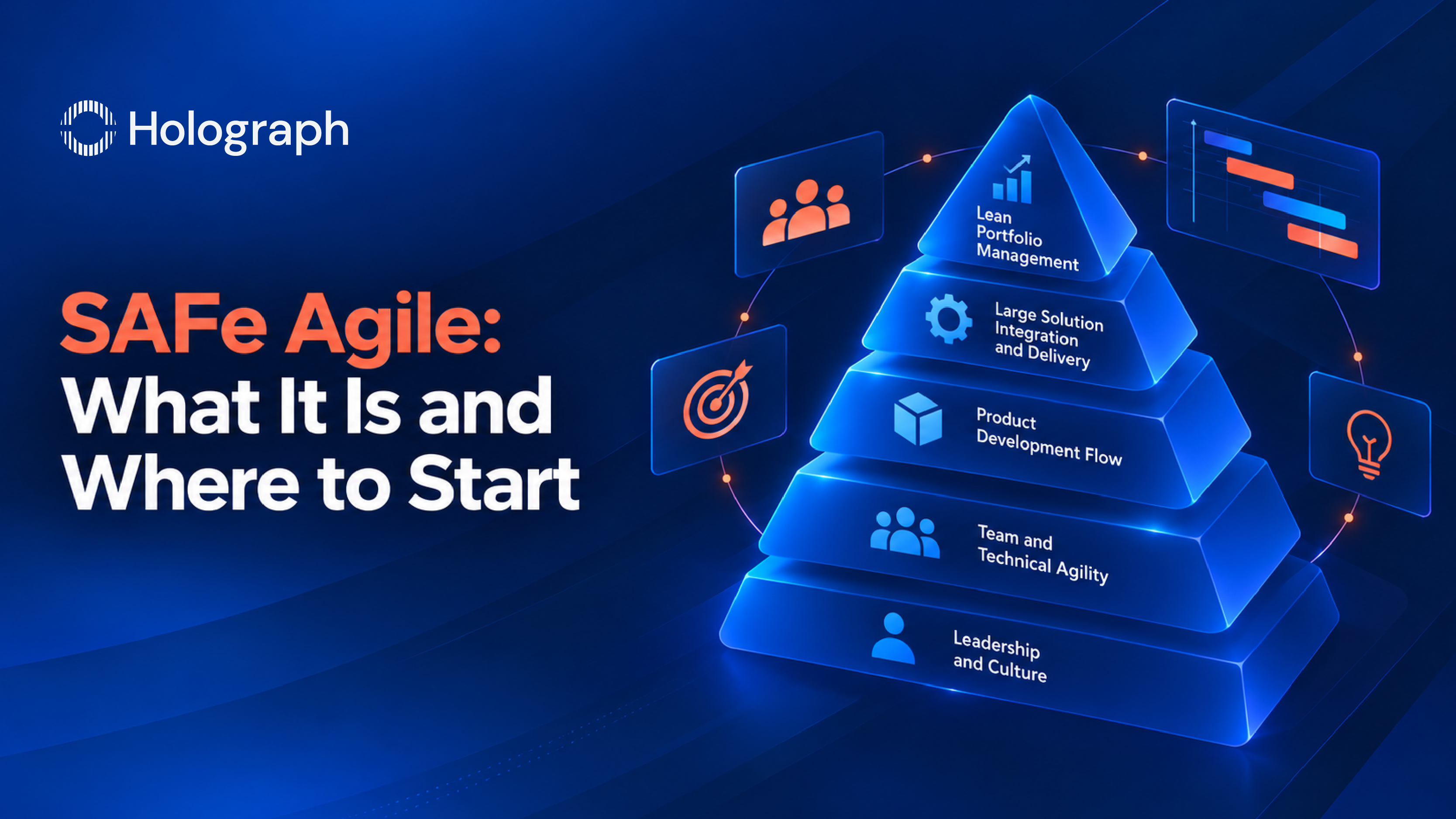
Scaled Agile's current site is built around what it calls the Five Disciplines of the Lean-Agile Organization: Leadership and Culture, Team and Technical Agility, Product Development Flow, Large Solution Integration and Delivery, and Lean Portfolio Management. Each discipline contains a set of competencies, and the site now frames each competency against a named business problem rather than a capability. One reads, in Scaled Agile's own words, "We struggle to execute our desired strategy across the existing portfolio structures."
That framing is more useful than it first appears. It means you can enter SAFe from the problem you actually have rather than from the top of a diagram, which is how most adoptions should start and how few of them do.
The site also presents Core SAFe and AI-Native SAFe side by side, and describes the second as an operating model aimed at returns on AI. Scaled Agile says the method is updated monthly, so any explainer, including this one, is a snapshot.
The configurations, and where to begin
Scaled Agile's SAFe 6.0 configurations page, last updated 3 September 2025, lists three: Full SAFe, Essential SAFe and Large Solution SAFe. Essential SAFe is the right entry point for most organizations starting out. Scaled Agile defines it as the minimal elements necessary for Agile Release Trains to deliver solutions and the simplest starting point for implementation, and it deliberately excludes Enterprise Solution Delivery and Portfolio concerns. It carries two foundation competencies, Lean-Agile Leadership and Continuous Learning Culture, and two delivery competencies, Team and Technical Agility and Agile Product Delivery. Scaled Agile also attaches ten critical success factors to it, described as what an ART needs to realize the majority of the method's benefits.
Starting with Full SAFe because it looks complete is a common and expensive mistake. Essential exists because the ART is where the value shows up first.
What an Agile Release Train actually is
The ART is the unit SAFe is built around, and it has a size. Scaled Agile defines it as a long-lived team of agile teams that incrementally develops, delivers and often operates one or more solutions in a value stream. An agile team is a cross-functional group of ten or fewer people. Each ART comprises five to fifteen of those teams.
Do the arithmetic and an ART lands somewhere between fifty and a hundred and fifty people. That number is worth holding onto, because it is almost exactly the band Atlassian uses to position Jira Plans, and it is the point where the tooling question stops being theoretical.
ARTs are described as virtual organizations that span functional boundaries and remove handoffs. They plan, commit and execute together, and the event that makes that real is PI planning, which Scaled Agile calls the heartbeat of the ART.
About the numbers SAFe publishes
Scaled Agile's About page carries four benefit ranges covering productivity, quality, time to market and employee engagement. We have read them and we are not repeating them here.
They are the method owner's figures for organizations adopting its method, published without a methodology on the page and without an independent source. That does not make them wrong. It makes them unsuitable as the basis for a business case you will be held to. Build the case on your own baseline instead: your current lead time, your current release frequency, your current rework rate. Those numbers are arguable with and they are yours.
SAFe and the tooling question
SAFe does not require a specific tool, and the decision is better made after the operating model than before it. The practical constraint is that the planning layer above your teams has to support the way of working you have chosen.
This is where the two Atlassian options separate. Jira Plans supports Scrum, Kanban and custom methods. Jira Align supports SAFe directly, along with LeSS, Spotify, Scrum@Scale and hybrid models. For an organization committed to SAFe that single difference usually settles it, and we work through the rest of that decision in our comparison of Jira Plans and Jira Align.
Getting the operating model right first
The question we get asked is whether an organization should adopt SAFe. The question underneath it is whether the organization is structured in a way SAFe can describe: whether value streams are identifiable, whether teams are stable and cross-functional, and whether leadership will fund and steer at the portfolio level rather than approving projects one at a time.
We start every engagement there, then design the portfolio structure, the planning cadence and the hierarchy before configuring anything. Holograph is an Atlassian Solution Partner with specializations in ITSM, Cloud, and DevOps, and this is Performance work: getting more from the Atlassian platform you already run. The full picture of the planning layer sits in the pillar guide.
If you are weighing a SAFe adoption, talk to us about Jira Align and we will start with a readiness assessment rather than a certification plan.
Frequently asked questions
What is SAFe agile?
SAFe is the Scaled Agile Framework. Scaled Agile defines it as a knowledge base of proven, integrated principles, practices and competencies for achieving business agility using Lean, Agile and DevOps. It is guidance you configure against how your organization delivers, rather than a process you install, and Scaled Agile updates it monthly.
What are the five SAFe disciplines?
Scaled Agile's current site is built around the Five Disciplines of the Lean-Agile Organization: Leadership and Culture, Team and Technical Agility, Product Development Flow, Large Solution Integration and Delivery, and Lean Portfolio Management. Each contains a set of competencies, and the site frames each competency against a named business problem rather than a capability.
What are the SAFe configurations?
The SAFe 6.0 configurations page, last updated 3 September 2025, lists Full SAFe, Essential SAFe and Large Solution SAFe. Essential SAFe is the simplest starting point and excludes Enterprise Solution Delivery and Portfolio concerns. Older explainers often list a fourth, Portfolio configuration, which is not on that page today.
What is an Agile Release Train?
An ART is a long-lived team of agile teams that incrementally develops, delivers and often operates one or more solutions in a value stream. An agile team is ten or fewer people and each ART comprises five to fifteen teams, so a train runs roughly fifty to a hundred and fifty people. ARTs plan, commit and execute together.
Where should an organization start with SAFe?
Start with Essential SAFe and one Agile Release Train rather than the full configuration. Scaled Agile positions Essential as the minimal set an ART needs to deliver, and attaches ten critical success factors to it. Starting at the top of the diagram produces an expensive model of a process the teams are not yet running.
Does SAFe require Jira Align?
No. SAFe does not require a specific tool. What it does require is a planning layer that supports the way of working you have chosen, and that is where the choice narrows. Jira Plans supports Scrum, Kanban and custom methods, while Jira Align supports SAFe directly alongside several other scaled models.
Assess readiness before the SAFe rollout