Strategic Portfolio Management: Funding Work at Delivery Speed
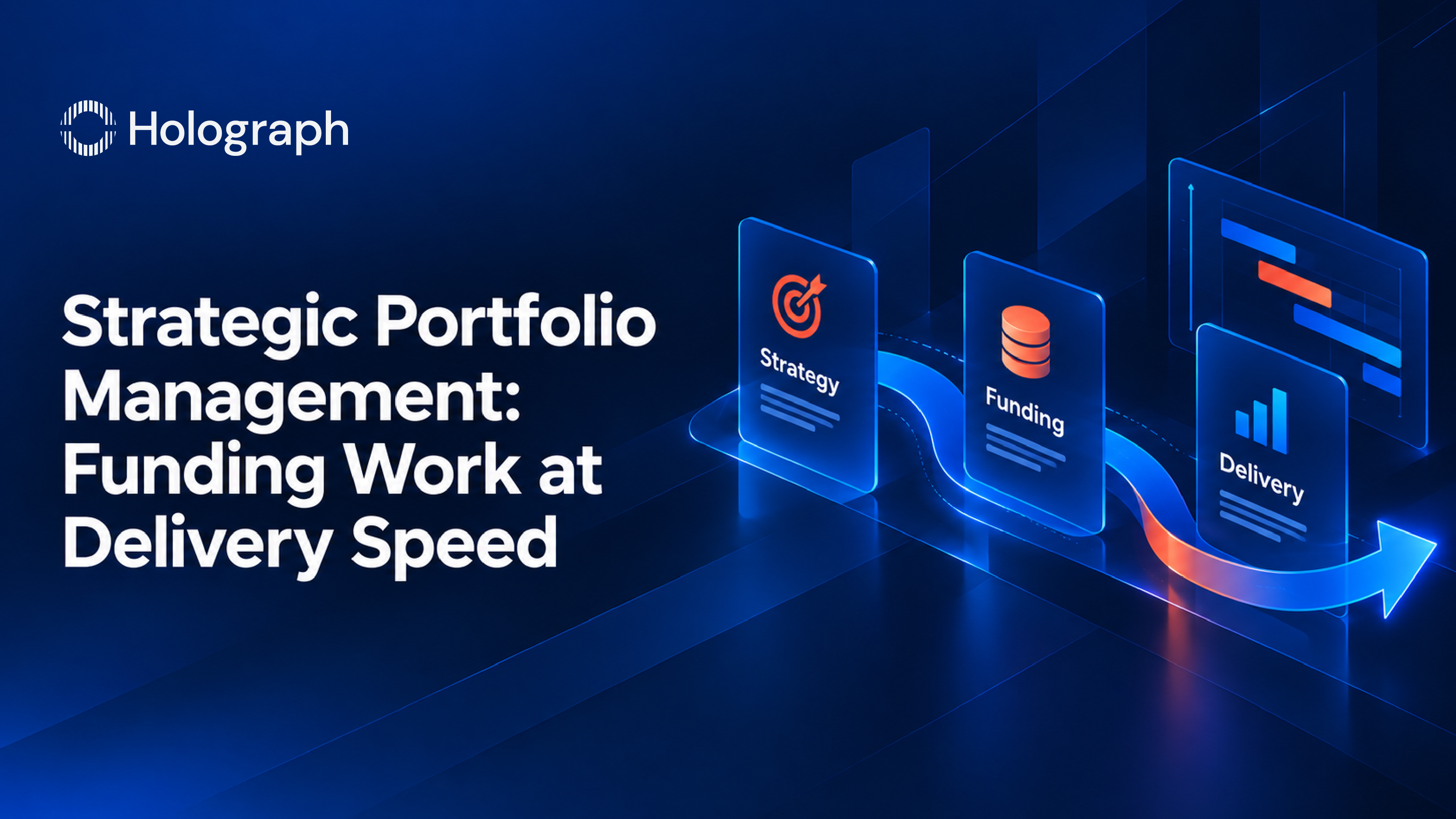
Finance commits the budget once a year. Delivery replans every quarter. The money does not move and the plan will not stop moving, and most portfolio trouble starts in that gap rather than in any team's backlog.
Jira Align's documentation names the problem. The portfolio room exists, in Atlassian's words, as "a bridge between the annual financial planning cycles of the business, and the PI (e.g., quarterly) cycles of the development pipeline." That is the brief for strategic portfolio management: keep the funding decision and the delivery decision on speaking terms. The planning layer that makes it possible sits in our guide to scaling agile with Jira Align.
What the discipline actually is
In SAFe the discipline is called Lean Portfolio Management. Scaled Agile defines it as a discipline that "aligns strategy and execution by applying Lean and systems thinking approaches to strategy and investment funding, Agile portfolio operations, and governance."
The unit being funded is the part people miss. Scaled Agile defines a SAFe portfolio as "a set of value streams that delivers a continuous flow of valuable solutions to customers within a common funding and governance model," and states that the portfolio budget "is directly allocated to these value streams rather than the traditional approach of project-based funding."
That one change carries most of the benefit and most of the resistance. A project budget buys a defined scope, while a value stream budget buys a standing capability and leaves the scope decision with the people closest to the work. Finance teams accustomed to approving line items find that uncomfortable, and they are right to ask what replaces the control.
Guardrails replace line-item approval
What replaces it is guardrails. Scaled Agile describes Lean Budget Guardrails as a way "to provide the right mix of investments to address both near-term opportunities and long-term strategy," and says they also "ensure that significant investments are approved and that the appropriate level of investment is allocated to technology, infrastructure, and maintenance."
The cadence matters as much as the mechanism. Value stream budgets are "typically updated twice annually (about every two PIs)," which anchors the budgeting horizon to the planning cadence rather than the calendar. On a quarterly PI, you revisit money every six months against plans the organization has already stress tested twice. How that planning cadence works is worth settling before you attach budgets to it.
One rule in the guidance deserves to be read out loud in the first session: "Previous investments from a prior budgeting period are sunk costs and ignored by LPM during decision-making." Most portfolio reviews fail that test.
The rename you will meet in the training material
The event where budgets get set has changed name, and Scaled Agile says so on its own page. "Reflecting this evolution, PB is transitioning to Strategic Investment Planning," with the definition now reading that it is "a collaborative process for allocating the portfolio budget to its value streams."
Scaled Agile also flags the lag: "While this transition occurs, courseware and other SAFe materials may still refer to Participatory Budgeting." Expect both terms in the room, and expect your training deck to use the older one.
The format is deliberate. Because "negotiations often break down with larger groups," the guidance is to split into groups of five to eight with a mix of roles from different value streams. Each value stream budget is then read in two parts: the baseline cost of running what already exists, and the proposed initiatives that would change it.
This is the fourth renaming in this set. Advanced Roadmaps became Jira Plans, Program Increment became Planning Interval, seven competencies became five disciplines, and now Participatory Budgeting becomes Strategic Investment Planning. Published guidance trails the source every time, so check the primary page before you quote a framework term in a steering meeting.
What Jira Align puts on the screen
Two rooms carry portfolio work, and they answer different questions. The portfolio room handles money. Atlassian describes it as "a control panel for your Portfolio Leadership team" and as an information radiator across three perspectives: financials, resources and execution. Its panels trace the flow of budget from themes to epics into programs and PIs, so a theme's allocated funding, estimated spend and accepted spend sit next to each other. Themes turn red when accepted spend exceeds allocated funding.
The strategy room handles outcomes. Atlassian describes it as "a unified view of your organization's short and long-term strategies, objectives, key results, and the execution of strategy," delivered through a strategy pyramid, an OKR heatmap, an execution against outcomes widget and an OKR tree. The heatmap scores key results on a fixed band: 0.3 and below reads red, 0.4 to 0.6 reads yellow, 0.7 and above reads green.
Between them, the leadership team gets one view of what was funded and one view of what it bought. Neither is worth much alone.
The setup cost nobody puts in the business case
The portfolio room has prerequisites, and they are specific enough to read before anyone promises an executive a dashboard. A strategic snapshot has to exist and be assigned to an organizational structure. The snapshot needs a budget. Strategic themes have to be established and allocated to PIs. PIs need budgets, those budgets need allocation across programs, and each PI needs a blended rate so that completed story points convert to currency. Every epic needs a strategic theme, a Strategic Value Score, an Effort SWAG, a budget on its spend tab and a target PI. Epics then need decomposition into features and stories, with stories estimated and allocated to sprints.
Skip the blended rate and the money panels stay empty. Leave themes without budgets and the variance bars have nothing to measure against. Park epics outside a portfolio objective and they drop out of the pyramid as misaligned work.
The strategy room has a related trap. Work items cannot be associated with North Stars, long-term goals or long-term strategies, so execution against outcomes at those levels always reads N/A. That is designed behavior rather than a configuration fault, and it generates a support ticket in most new instances.
Where this sits in the rest of the stack
Lean Portfolio Management is one of the five disciplines in SAFe, and it is the one that cannot run on team tooling alone. The portfolio view assumes themes, epics, strategic snapshots and PI budgets exist as first-class objects with money attached, which is the line that separates the two Atlassian planning layers.
We sequence this work in the order the data depends on. Agree the value streams, then the themes, then the snapshot and its funding levels, then the PI budgets and the blended rate, and only then the epic-level fields. Teams that start at the epic level build a careful spend model on a structure nobody has agreed, and the first portfolio review spends its hour arguing about the structure.
Holograph is an Atlassian Solution Partner with specializations in ITSM, Cloud, and DevOps, and this is Performance work: getting more out of the Atlassian platform you already run.
If your budget cycle and your delivery cycle have stopped talking to each other, talk to us about Jira Align and we will start with your portfolio structure rather than your dashboard.
Frequently asked questions
What is strategic portfolio management?
Strategic portfolio management is the practice of allocating and governing investment so that funding decisions keep pace with delivery. In SAFe the discipline is called Lean Portfolio Management, which Scaled Agile defines as aligning strategy and execution through Lean and systems thinking applied to strategy and investment funding, Agile portfolio operations, and governance.
What is the difference between project funding and value stream funding?
A project budget funds a defined scope for a fixed period. A value stream budget funds a standing capability and leaves prioritization with the value stream. Scaled Agile states that the portfolio budget is allocated directly to value streams rather than through project-based funding.
What are Lean Budget Guardrails?
Guardrails are the controls that replace line-item approval. Scaled Agile describes them as a way to provide the right mix of investments across near-term opportunities and long-term strategy. They also make sure significant investments are approved and that technology, infrastructure and maintenance get an appropriate share.
Has Participatory Budgeting been renamed?
Yes. Scaled Agile states that Participatory Budgeting is transitioning to Strategic Investment Planning, defined as a collaborative process for allocating the portfolio budget to its value streams. Scaled Agile notes that courseware and other SAFe materials may still refer to Participatory Budgeting.
How often are value stream budgets reviewed?
Scaled Agile states that value stream budgets are typically updated twice annually, about every two PIs. Where the PI cadence is quarterly, that places the budgeting horizon at six months.
What do the portfolio room and strategy room show in Jira Align?
The portfolio room is a control panel for the portfolio leadership team covering financials, resources and execution, and it traces budget from themes to epics into programs and PIs. The strategy room covers strategies, objectives, key results and execution through a strategy pyramid, an OKR heatmap, an execution against outcomes widget and an OKR tree.
What has to be configured before the portfolio room shows data?
A strategic snapshot assigned to an organizational structure and given a budget, themes allocated to PIs, PI budgets allocated across programs, and a blended rate on each PI so story points convert to currency. Every epic needs a theme, a Strategic Value Score, an Effort SWAG, a budget and a target PI, and epics need decomposition into estimated stories.
Make the portfolio structure hold before the dashboard