Enterprise Security Posture: Why Patching Breaks at Scale
Between 17 and 28 October 2026, three security failures landed in public inside eleven days. Two critical flaws in PHP let an unauthenticated request run code on a web server. Eight certificate authority keys turned out to be small whole numbers that anyone could guess. India's largest bank confirmed that thousands of customer records had been published on the dark web.
The instinct is to read that as three arguments for buying more tooling. It is the wrong reading. Not one of the three was caused by a control nobody had thought of. The PHP flaw was fixed by a patch available on the day it was disclosed, and the open question was whether an organization could find every instance it ran before somebody else did. The certificate keys were generated inside certified hardware, by an organization that passed two independent audits afterwards. The bank had threat intelligence. It arrived from outside.
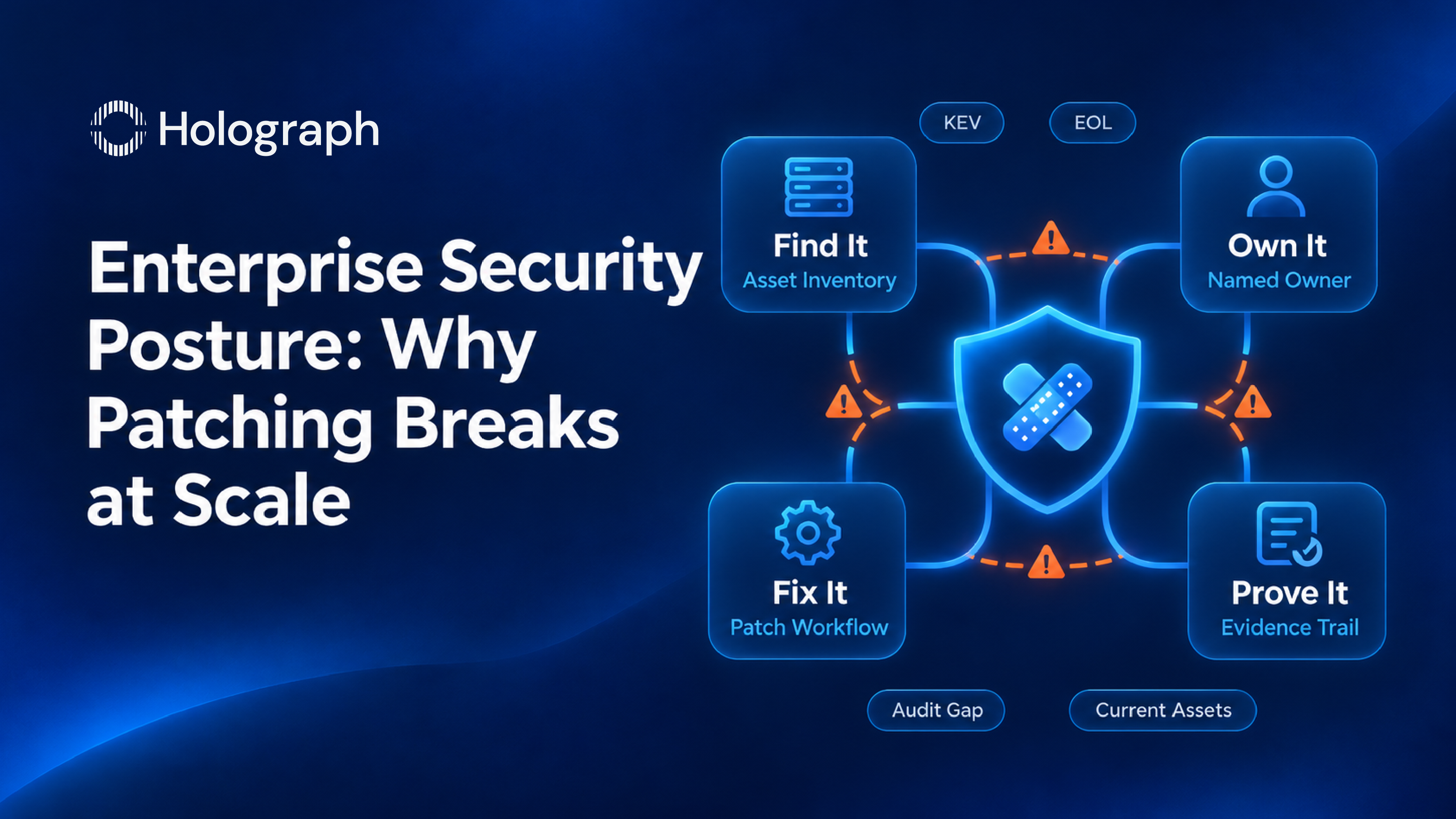
Find it, own it, fix it, prove it. Those four verbs are where enterprise security posture actually lives, and all three failures happened in the gaps between them.
What October actually showed
A patch you cannot locate is not a patch
On 21 October 2026 the PHP project released versions 8.5.12, 8.4.27, 8.3.36 and 8.2.35 to fix two vulnerabilities, CVE-2026-109618 and CVE-2026-109619, each rated CVSS 9.2. Both allow unauthenticated remote code execution. The project's advisory is blunt about the options: there are no complete mitigations, and updating is the only safe choice.
Five days later, CISA added both to its Known Exploited Vulnerabilities catalog. That listing changes what the problem is. A CVE is a risk to assess on your own schedule. A KEV entry is a deadline, and for anyone answering to a federal customer, an auditor or a cyber insurer, it is the date the clock started.
Then comes the part no advisory can help with. PHP sits underneath a great deal of software that nobody ever described as a PHP application. Every version from 5.4 through 8.5.11 is affected, and 8.1 and earlier receive no fix at all, because they have reached end of life. Knowing that you must patch is the easy half. Knowing where is the half that needs an asset inventory somebody kept current.
An audit that passes is not a control that works
On 17 October a researcher reported that the private keys of eight intermediate certificate authorities operated by eMudhra could be recovered from the public certificates. These were P-384 keys, which should carry roughly 384 bits of entropy. The real values were whole numbers below 256. One of them was four.
The keys were generated on hardware security modules certified to FIPS 140-2 Level 3, in a formal ceremony held in April 2025. eMudhra's own account is that a flaw in the ceremony script produced a second, weaker key pair alongside the intended one, and that the weak set was the one published to the browser root stores. The hierarchy then sat in browser trust lists for eighteen months, through two independent audit cycles, before anyone noticed.
Browsers moved in hours. Chrome blocked the affected keys the same evening and later removed the associated root. The slower problem belongs to everything that is not a browser. A good deal of software validates certificates without consuming revocation data at all, and keeps trusting a chain until its code or its root bundle is updated. For those systems the fix is a release rather than a push, and somebody has to own shipping it.
Detection you buy is still detection you do not have
On 21 October, State Bank of India told the stock exchanges that a preliminary analysis of approximately 375,000 records circulating on the dark web had identified 3,897 customer records containing personal data. The exposed fields included names, registered mobile numbers, dates of birth, email and residential addresses, branch and customer identifiers, and metadata attached to loan records.
The detail that matters when you are designing a posture is how the bank found out. It was alerted by its threat intelligence provider, by the Defence Cyber Agency and by CERT-In. The data was already public by then. Later reporting records a police complaint describing the theft as having taken place between 10 and 15 October, which puts a week between the event and the first alert from outside.
The four questions a posture has to answer
Most security programs can produce a policy on request. Fewer can answer these four without calling a meeting.
Where does it run
An advisory names a product and a version. Your estate is organized by team, by business unit and by budget code. Reconciling those two views under time pressure is the commonest reason a patch lands late, and a spreadsheet somebody updated last quarter will not do it. What works is asset data that maintains itself and is joined to the ticket system, so that "what is affected" returns a list instead of a thread.
Who owns it
An advisory mailed to a distribution list has no owner. Work with a named owner and a due date gets done, and work without either waits for a volunteer. The design that holds up makes criticality a property of the asset rather than a judgment made fresh during each incident, because that is what lets routing and response times be decided in advance.
How does it get fixed
Emergency patching is where change management either earns its keep or quietly gets bypassed. A process that cannot approve an urgent patch within a day will be worked around, and the workaround becomes the real process. The test is not whether you have a change advisory board. It is whether that board can meet, decide and record the decision faster than the exploit window closes.
How do you prove it
Auditors and insurers do not accept the assertion that patching happened. They accept evidence: when the advisory arrived, what was found, who approved the change, when it shipped, and what was verified afterwards. If that record has to be assembled by hand months later it will have holes in it, and the cost of an incident keeps growing long after the technical work is done.
Why the checklist is not the hard part
Atlassian publishes detailed security guidance for its own products. It covers dedicated service accounts, directory permissions, single sign-on and multi-factor authentication, secure administrator sessions, rate limiting and audit log configuration. Comparable material exists for every major enterprise platform, and much of it is free. The configuration question is, for practical purposes, answered.
That is worth saying plainly, because a lot of security writing treats the list as the difficulty. The failure we are called in to fix is almost never a setting nobody had heard of. It is a setting nobody owned, on a system nobody had inventoried, patched through a process nobody had tested under pressure.
End of life is a security position, not a procurement date
PHP 8.1 and earlier receive no fix for either October vulnerability. That is not a backlog item with a date on it. It is a permanent exposure, and the only remedy is to stop running it.
The same shape is now scheduled across the Atlassian estate. Atlassian stops selling new Data Center subscriptions, Marketplace apps and expansions to existing customers after 30 March 2028, and impacted Data Center products reach end of life on 28 March 2029, when subscriptions expire and the products become read-only. Bitbucket and Bamboo Data Center are excepted and continue past that date. We set out the full timeline, the product exceptions and what they mean for a migration plan in our Atlassian Data Center end of life roadmap.
Reading those dates as a licensing question is the mistake. A supported version is the mechanism by which security fixes reach you at all. When support ends, the next advisory arrives with no patch attached to it.
What it looks like when the operating model is built
The pattern holds across platforms and industries. Security tooling feeds the service desk rather than a separate console, so a detection becomes a ticket with an owner rather than an alert somebody may read. Asset data is integrated rather than hand-maintained, so criticality is already known when it is needed. Incident assignment runs against that data, so the right team is working within minutes. Response times differ according to what was attacked, because a trading platform and a test instance do not deserve the same clock.
And where the vendor has no patch, the gap gets closed with work built to industry practice rather than left open until the vendor ships one. That last point deserves its own line, because it is the one most plans omit. Vendors do not patch everything, and the advisory that tells you so arrives on the same day as the one that tells you to hurry.
The pipeline half of this sits in our guide to building security into the delivery pipeline. The service management foundations sit in our enterprise ITSM guide, and the mechanics of routing and response times in our work on reducing ticket resolution time.
Holograph is an Atlassian Solution Partner with specializations in ITSM, Cloud, and DevOps. Work of this kind is Performance work: getting more out of the platforms you already run by making their security operable. You can see the shape of it in our cyber security services.
Case studies
MCX. The Multi Commodity Exchange of India is a government-regulated commodity derivatives exchange founded in 2003. Monthly threat simulations surfaced vulnerabilities in its Jira, Confluence and Bitbucket deployment that needed immediate resolution to stay compliant with government regulations. Some of those issues had no direct security patch from Atlassian, so we built custom solutions using industry best practices and third-party technologies including Apache Tomcat. The engagement also moved the estate from server-based systems to Atlassian's Data Center edition while protecting data integrity.
Angel One. One of India's leading full-service retail brokerage firms, founded in 1987 and headquartered in Mumbai, ran several security tools that could not feed Jira Service Management, because the Atlassian Cloud edition offered no native functionality for it. We built a custom app to close that gap, automated the assignment of security incidents by system, threat area and affected asset, configured service levels dynamically against the criticality of the attacked asset, integrated Jira with Device42 for asset data, and automated ticket generation.
Tawuniya. Saudi Arabia's first national insurance company had implemented 24 of the 33 ITIL 4.0 best practices and needed the remainder assessed and matured. We ran a gap assessment, documented the practices with named action items and owners, and delivered a tested framework. The engagement also closed security vulnerabilities arising from outdated product editions and brought data hosting into line with Saudi Arabian regulations.
ZATCA. The Zakat, Tax and Customs Authority was running an outdated Jira version, 8.22.x, with performance consequences. We upgraded it, configured and optimized the disaster recovery system for swift failover, and integrated Jira with the authority's in-house Dewa system so that change information synchronized automatically for the change advisory board and release management teams.
If an advisory landed today, could you name every system it touches and who owns the fix? Talk to us about a posture review of the platforms you already run.
Frequently asked questions
What is security posture management?
Security posture management is the continuous practice of knowing what you run, what condition it is in, and who is accountable for changing it. It differs from a point-in-time audit in that it is designed to answer questions during an incident rather than to produce a report afterwards. In practice it rests on current asset data, clear ownership, a change process that works under time pressure, and an evidence trail produced as a by-product of the work.
How do you decide which vulnerabilities to patch first?
Three inputs settle most cases. Whether the vulnerability is being exploited in the wild, which is what a listing in the CISA Known Exploited Vulnerabilities catalog tells you. Whether the affected system is reachable from the internet. And how much the business depends on the affected asset, which should already be recorded against it rather than debated during the incident.
What is the CISA Known Exploited Vulnerabilities catalog?
It is a list maintained by the United States Cybersecurity and Infrastructure Security Agency of vulnerabilities with confirmed exploitation. CISA added CVE-2026-109618 and CVE-2026-109619 to it on 26 October 2026. Inclusion matters beyond federal agencies, because auditors, insurers and enterprise customers increasingly treat the catalog as the line between a risk you may schedule and one you must act on.
What happens when there is no patch?
Two situations produce this, and they need different answers. If the vendor has not yet shipped a fix, the gap is held with compensating controls and custom work until one arrives. If the version has reached end of life, no fix is coming at all, and the only genuine remedy is to move off it. Treating the second case as though it were the first is how exposures become permanent.
Who should own patching, IT operations or security?
Ownership works best when security sets the standard and the deadline while operations holds the asset and performs the change, with both recorded in the same system. The arrangement that fails is the one where an advisory is forwarded to a distribution list and no individual name is attached to a date.
How do you prove patch compliance to an auditor?
By showing the chain rather than asserting the outcome: when the advisory was received, which assets were identified as affected, who approved the change, when it was deployed, and what verification was performed. The practical test is whether that chain can be produced from your existing systems without anyone reconstructing it from memory and email.
Is running end of life software a compliance problem or a security problem?
Both, and the security problem comes first. End of life means security fixes stop being issued, so the exposure is permanent rather than pending. The compliance consequence follows from that, because frameworks and insurers expect supported software, and an unsupported platform is difficult to defend in an audit regardless of how carefully it is configured.
See what we actually fixed