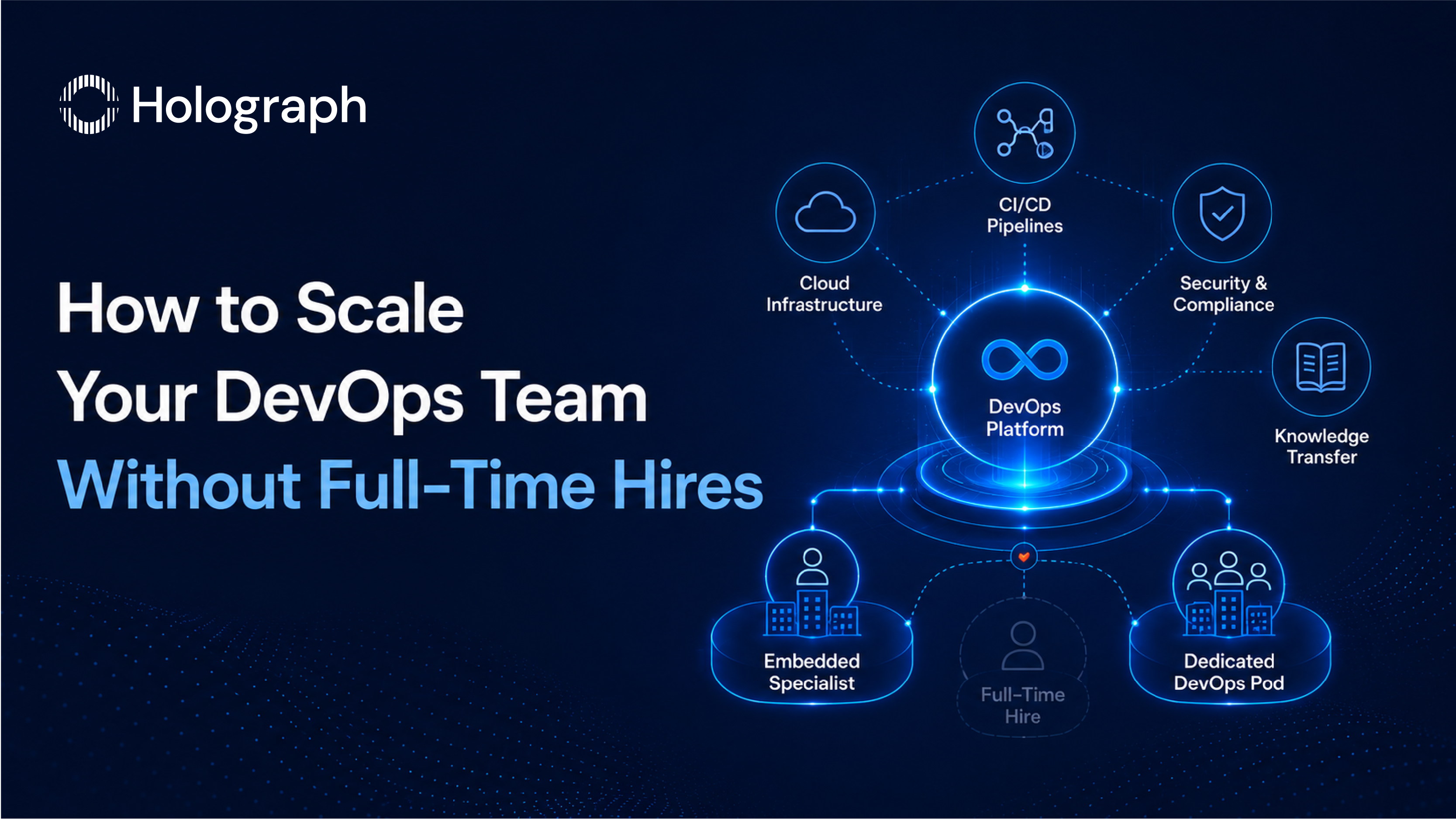
How to Scale Your DevOps Team Without Full-Time Hires
DevOps work at enterprise scale does not arrive at a steady rate. It concentrates at delivery inflection points: a CI/CD pipeline that needs to be built from scratch, a cloud migration that requires the pipeline to be redesigned around the target environment, a security uplift programme that demands integration controls at every stage of the build and deployment process. During those periods, the demand for certified DevOps expertise is high and the work is genuinely complex. Once the pipeline is live and the internal team has taken over steady-state operations, that same expertise is largely idle.
This intensity pattern is the root of the talent access problem in DevOps. Full-time DevOps architects are expensive to hire, typically take four to six months to bring on board, and are over-resourced for the operational role that exists after a successful build. The enterprise ends up retaining a specialist at full-time cost for work that no longer matches the expertise they were hired to apply. The specialist, no longer challenged, eventually leaves. The institutional knowledge of the pipeline leaves with them.
This post covers the structural talent gap in enterprise DevOps, why the variable-intensity demand pattern makes full-time hiring a poor fit for most DevOps work, the two augmentation models that resolve the mismatch, how augmented DevOps specialists integrate with existing engineering teams, what certified DevOps expertise means in practice, and how to evaluate a partner before committing.
For the full framework on when augmentation is the right model versus outsourcing or direct hire, see the IT Staff Augmentation guide.
The DevOps Talent Gap at Enterprise Scale
Enterprise-grade DevOps is a design discipline, not a tooling skill. The engineer who can architect a CI/CD pipeline that meets production governance requirements at enterprise scale, including security gates at the commit, build, and deployment stages; infrastructure as code that is reproducible and testable; deployment rollback that works cleanly across interdependent services; and monitoring architecture that surfaces pipeline failures before they reach production, has built that knowledge through implementations at scale. It does not transfer directly from development work or general IT administration.
The distinction between using DevOps tools and architecting DevOps pipelines is consistent across the stack. A developer who uses Jira Software daily understands their sprint board and backlog. An Atlassian-certified DevOps specialist knows how to configure Jira Software so that the board reflects the team's actual development workflow, how Bitbucket pipelines integrate with deployment targets across multiple environments, and how the toolchain connects to ITSM processes managed in Jira Service Management. The configuration decisions that determine whether a DevOps investment produces measurable engineering velocity or adds process overhead without benefit require the second level of knowledge, not the first.
The talent pool for certified DevOps expertise is concentrated and competitive. Atlassian's Data Center end-of-life timeline, announced in 2025 with new-customer license sales ending in March 2026 and full end of life on 28 March 2029, has made cloud migration a planned requirement for a significant portion of enterprise Atlassian environments, compressing an already tight market further. Senior DevOps engineer roles in enterprise contexts typically take four to six months to fill. Enterprises competing against technology firms and larger consultancies with broader remits and higher salary bands face a structural disadvantage in direct hire. The market rate reflects the scarcity; the retention rate, once the hire is made, reflects it again.
Why Full-Time Hiring Mismatches the Work
The demand pattern for certified DevOps expertise inside a typical enterprise IT environment is not flat. It peaks during the build phase of a platform implementation or migration: pipeline architecture decisions, tool configuration, security integration, and the iterative testing and hardening work that determines whether the pipeline performs at scale. It levels off considerably once the pipeline is live and the internal team is operating it.
An enterprise that hires a senior DevOps architect to lead a pipeline build and then retains that architect at full-time cost during steady-state operations has created a headcount overhead. The role shifts from architecture to administration and incremental optimisation work. The specialist's certified expertise is not the primary requirement of the day-to-day role. Within 18 months, the specialist has either been given a new pipeline project or has found one elsewhere.
The second problem with direct hire for variable-intensity DevOps work is knowledge concentration. The specialist who built the pipeline understands why particular decisions were made, where the edge cases sit, and what the security architecture depends on. When they leave, that understanding goes with them. The internal team operating the pipeline is not necessarily equipped to make the architectural decisions that arise when requirements change or the pipeline needs to scale. Rebuilding that institutional knowledge takes time and often takes a new hire.
Direct hire is the right decision when the DevOps role will be continuous, genuinely complex, and used at high intensity indefinitely. A large enterprise running a complex multi-cloud environment with weekly architectural decisions and ongoing pipeline development across multiple product teams may justify a full-time DevOps solution architect. For most enterprises, that describes a small share of their DevOps work. The rest is project-scoped, and project-scoped work fits a different commercial model.
The Two Augmentation Models for DevOps
Two delivery structures address the variable-intensity demand pattern in DevOps without the permanent overhead of a full-time hire.
Embedded DevOps specialist. A single certified engineer placed into the client engineering team for a defined engagement period. The specialist works inside the team's sprint cycles, attending standups, sprint planning, and retrospectives in the same project management tools as the internal engineers. They commit to the same Bitbucket repositories with the same code review processes. Their pipeline work is visible to the internal team in real time, not delivered as a completed output. This structure suits a focused engagement where one or two DevOps specialisations are required, the project timeline is defined, and a single specialist provides sufficient depth and bandwidth.
Dedicated DevOps pod. A structured team of certified DevOps engineers assigned exclusively to one client for a sustained programme. Pod composition is built around the client's requirements: a pipeline architect, a cloud infrastructure engineer, and a security specialist for a complex multi-cloud pipeline rebuild; a smaller two-person configuration for a targeted Atlassian DevOps toolchain implementation. The pod operates with full attention on the client's scope across several months, providing the multi-specialisation coverage and sustained delivery bandwidth that a single embedded specialist cannot.
Both structures include knowledge transfer as a scoped deliverable at the close of the engagement. Architecture decision logs, runbooks for the internal team, configuration documentation in the team's standard documentation system, and a defined handover period in which the internal team operates independently before the specialist exits are specified at the start, not negotiated at the end.
How Augmented DevOps Specialists Integrate With Engineering Teams
The integration question that most CTOs and Engineering Managers raise before their first DevOps augmentation engagement is practical: how does an external specialist work inside an existing team without creating a parallel structure or accumulating context that stays external?
An embedded DevOps specialist works inside the client team from day one. They are added to the relevant sprints in Jira Software alongside internal engineers. They attend the same standups, retrospectives, and architecture reviews. They commit to the same repositories under the same review processes. The pipeline work they produce is visible in real time across the team's shared tools, not delivered as a finished output that the internal team receives without seeing how it was built.
This integration model is what makes knowledge transfer substantive rather than ceremonial. When the specialist makes a pipeline architecture decision, the internal team does not receive only the configuration; they observe the reasoning in the sprint context where it is discussed. When the specialist writes infrastructure as code, it is reviewed by internal engineers in the standard code review process. When they configure a security gate, the configuration and its rationale are documented in the shared documentation system.
The structural requirements for effective integration are straightforward. The client team lead owns scope and priority decisions. The augmented specialist owns delivery quality within their scope. The client provides access to their tools, environments, and repositories from day one. The handover plan is written at the start of the engagement, reviewed at the midpoint, and executed at the close.
What Certified DevOps Expertise Means
For enterprise DevOps augmentation, two credential dimensions carry weight. A third applies specifically to enterprises with security or regulatory requirements.
Atlassian Solution Partner DevOps specialisation. For enterprises running Jira Software, Bitbucket, and related Atlassian tooling as the basis of their DevOps workflow, the Atlassian Solution Partner DevOps specialisation indicates certified delivery experience with the Atlassian DevOps toolchain at the organisational level. This covers Jira Software configuration for engineering workflow management and meaningful reporting, Bitbucket pipeline architecture and branch strategy design, CI/CD integration with deployment targets across development, staging, and production environments, and how the Atlassian DevOps toolchain connects to ITSM processes in Jira Service Management. The specialisation is assessed by Atlassian at the partner organisation level, not self-declared.
AWS delivery experience. For enterprises running CI/CD pipelines on AWS, demonstrated delivery experience with AWS CodePipeline, CodeDeploy, CloudFormation, and CDK indicates that the specialist understands the cloud infrastructure layer that pipelines operate on. The AWS Advanced Tier Services Partner designation at the organisational level indicates validated delivery experience across the AWS service portfolio, independent of the individual engineer's certifications.
Security integration in the pipeline. For enterprises with regulatory compliance requirements or elevated security postures, an enterprise-grade CI/CD pipeline integrates security controls at multiple stages: static analysis tools at the code commit stage without adding excessive wait time to developer workflow; secret scanning in the CI/CD configuration to prevent credentials reaching repositories; container image scanning before deployment; infrastructure compliance checks in the IaC layer. A specialist who describes how they embed these controls without degrading pipeline performance has worked through the engineering trade-offs at enterprise scale.
For the full evaluation framework across technology ecosystems, see IT Staff Augmentation vs IT Outsourcing and How to Hire Certified Atlassian Engineers Without Full-Time Headcount.
How to Evaluate a DevOps Augmentation Partner
Verify the relevant credential. For Atlassian-based DevOps work, the Atlassian Solution Partner DevOps specialisation should appear as active in Atlassian's partner directory. For AWS pipeline and infrastructure work, the AWS Advanced Tier Services Partner designation. Both are vendor-issued and require an independent assessment process. Credentials claimed without a verifiable directory entry carry no independent verification.
Ask how they approach security integration in CI/CD pipelines. This question separates pipeline architects from tool operators. A capable DevOps specialist describes the specific stages where security controls sit in the pipeline, how those controls are configured to avoid creating hours of wait time for developers, and how violations in one stage are handled before the pipeline proceeds to the next. A generalist describes which tools they install and when reports are run.
Ask about rollback architecture. Production deployments fail. How a specialist designs rollback across interdependent services, particularly in microservices architectures where a failed deployment in one service creates downstream failures in others, reveals whether they have worked through these scenarios at enterprise scale. The value is in whether the specialist has a considered, specific methodology, not in the answer matching a particular pattern.
Ask how knowledge transfer is structured as a deliverable. An augmentation partner who cannot describe their knowledge transfer process in specific terms has not operationalised it. The answer should include: architecture decision logs maintained during the engagement, runbooks written for the internal team before the specialist exits, a defined handover period in which internal engineers operate independently before close, and configuration documentation maintained in the client's standard documentation system throughout.
Holograph's DevOps Capability
Holograph holds Atlassian Solution Partner status with a certified DevOps specialisation and AWS Advanced Tier Services Partner status. Certified DevOps engineers are available as embedded specialists and dedicated pods, delivering CI/CD pipeline implementation with embedded security from Holograph's Global Capability Center across the USA, KSA, UAE, and India. Holograph serves 170+ enterprise clients across financial services, manufacturing, software development, government, insurance, and automotive.
For the decision between augmentation and outsourcing for DevOps work, see IT Staff Augmentation vs IT Outsourcing. For Atlassian-specific DevOps toolchain implementation and certified Atlassian specialists, see How to Hire Certified Atlassian Engineers Without Full-Time Headcount. For Holograph's full DevOps service scope, see the DevOps services page.
The Model That Fits the Work
Scaling a DevOps team without full-time hires works when the delivery model matches the scope and intensity of the work. Embedded specialists for focused pipeline builds, cloud migration DevOps work, and security integration engagements where one or two certified specialisations are required. Dedicated pods for sustained multi-specialisation programmes where a single specialist cannot cover the required depth and bandwidth.
Both structures close with knowledge transfer built into the engagement scope from the start. The internal team operates what was built. The specialist's certified expertise is no longer required to sustain it. The enterprise accessed the depth it needed without the permanent cost of retaining it.
The evaluation criteria for a DevOps augmentation partner are consistent: certified specialisation in the relevant practice area, delivery evidence at comparable enterprise scale, security integration knowledge that goes beyond tool familiarity, and a knowledge transfer process specified as a deliverable before the engagement begins.
Holograph provides certified DevOps engineers as embedded specialists and dedicated pods, with Atlassian DevOps and AWS specialisations. See DevOps services.
Frequently Asked Questions
What is DevOps staff augmentation?
DevOps staff augmentation adds certified DevOps engineers to an existing internal engineering team for a defined scope of work, under the client team's direction. The specialist works inside the team's sprint cycles, repositories, and pipeline tools. The client retains ownership of the outcomes. Two delivery structures apply: embedded specialists for focused, project-scoped engagements and dedicated pods for sustained programmes requiring multiple specialisations. Knowledge transfer to the internal team is a scoped deliverable in both structures.
When should you augment your DevOps team instead of hiring full-time?
Augmentation fits when DevOps work is project-scoped or variable in intensity: a pipeline build, a cloud migration, a security uplift, or a DevOps toolchain configuration. Direct hire fits when the enterprise needs a specialist in a continuous, high-intensity role indefinitely. The common failure is applying direct hire to project-scoped work: the specialist builds the pipeline, the role stabilises, the expertise no longer matches the day-to-day work, and the institutional knowledge of what was built concentrates in the person who eventually leaves.
How do augmented DevOps engineers integrate with existing engineering teams?
An embedded DevOps specialist works inside the client team from day one: added to sprints in Jira Software, committing to Bitbucket repositories under the same review processes, attending standups and retrospectives alongside internal engineers. The work is visible in real time, not delivered as a finished output. This makes knowledge transfer substantive: the internal team observes the pipeline design process as it happens, not just the outcome it produces. Access to tools and repositories is provided from the start of the engagement.
What certifications should a DevOps augmentation specialist hold for enterprise work?
For Atlassian-based DevOps work, the Atlassian Solution Partner DevOps specialisation at the organisational level indicates certified delivery experience with the Atlassian DevOps toolchain. For AWS pipeline and infrastructure work, the AWS Advanced Tier Services Partner designation indicates validated delivery experience across the AWS service portfolio. For enterprises with compliance requirements, demonstrated security integration experience in CI/CD pipelines (SAST at commit, secret scanning, container image scanning, IaC compliance) is a third relevant dimension beyond platform credentials.
What is a dedicated DevOps pod and when does it make sense?
A dedicated DevOps pod is a structured team of certified DevOps engineers assigned exclusively to one client for a sustained engagement. Pod composition is built around the client's scope: a pipeline architect, a cloud infrastructure engineer, and a security specialist for a complex multi-cloud pipeline rebuild; a smaller configuration for a targeted toolchain implementation. The model applies when the DevOps programme requires multiple specialisations or sustained delivery bandwidth that a single embedded specialist cannot provide.
How do you evaluate a DevOps augmentation partner before committing?
Four checks. Verify the relevant credential (Atlassian Solution Partner DevOps specialisation or AWS Advanced Tier Services Partner status) in the vendor's partner directory. Ask how they approach security integration in CI/CD pipelines; the answer separates architects from tool operators. Ask about rollback architecture across interdependent services; the specificity of the answer reveals enterprise-scale delivery experience. Ask how knowledge transfer is structured as a named deliverable in their engagement model.
Scale your DevOps team without the full-time cost