IT Staff Augmentation vs IT Outsourcing: Which Model Fits Your Organisation

The decision to outsource an IT function and the decision to augment the IT team look similar from the outside. Both bring in external expertise. Both involve an external partner. Both appear on a procurement shortlist under the same budget heading. The commercial similarity is where the resemblance ends.
Structurally, the two models are different in ways that matter: who owns what, who controls the work, what knowledge stays with the organisation when the engagement concludes, and which type of work each model is suited to. Making the wrong choice based on cost comparison alone creates problems that surface 12 to 24 months in: after the contract is signed, the work is underway, and unwinding it is expensive.
This post covers the structural differences between staff augmentation and outsourcing, which work suits each model, and how to make the decision before committing to either. For the full overview of the three talent access models, including direct hire, see the IT Staff Augmentation guide.
What Each Model Actually Means
The working definitions matter because they are frequently blurred in vendor conversations.
Staff augmentation adds certified external specialists to an internal IT team. The specialists work under the client team's direction, within the client's tools, processes, and sprint cycles. The client retains ownership of the function and its outcomes. The specialist's expertise is available to the client's team; the management of that expertise stays with the client.
Outsourcing transfers operational responsibility for a function to an external provider. The provider delivers against a defined service contract. The client specifies the outcome; the provider determines how to achieve it. Day-to-day operational control moves to the provider. The client retains ownership of the business result, not of the function that produces it.
The distinction is ownership of process, not just ownership of outcome. That distinction determines which model is appropriate for which type of work.
The Ownership Dimension
Ownership is the primary variable in this decision, and it is the one most frequently absent from procurement conversations that focus on day rate versus service fee.
In an augmentation arrangement, the IT Director or Engineering Manager who commissions an augmented specialist continues to direct that specialist's daily work. Priority shifts, scope adjustments, integration requirements from other teams, and decisions that reflect the client's specific technical context all remain under the client's direct control. The specialist is operationally part of the client team.
In an outsourcing arrangement, the contract governs the relationship. The client cannot direct the provider's staff in the way an employer directs an employee. Formal change management processes govern scope adjustments. Priority changes require notice periods or contract amendments. The provider has operational autonomy within the service boundary the contract defines.
Neither structure is inherently superior. The ownership structure that fits depends on whether the work requires daily client direction or whether it can be managed at the contract boundary.
Which Work Suits Which Model
The nature of the work determines the appropriate model more reliably than the cost comparison does.
Functions That Suit Outsourcing
Outsourcing is structurally appropriate for work that is commoditised, outcome-measurable, and low in contextual dependency. The test: can the outcome be fully specified in a contract before the work begins? If yes, outsourcing is a legitimate option.
Tier-1 helpdesk operations are the standard example. The outcome (tickets resolved within defined SLA parameters) is measurable. The process by which agents resolve those tickets does not need to reflect the client's institutional knowledge of their own systems. The work is predictable, repeatable, and contractable.
Basic infrastructure monitoring follows the same logic. Network availability monitoring, server uptime alerts, and commodity patch management are functions where the provider can perform the work without deep knowledge of the client's architecture, business processes, or decision history.
Functions That Suit Augmentation
Enterprise platform work (Atlassian ITSM implementation, cloud architecture design, DevOps pipeline configuration, SLA tier design) is contextual by nature. The correct ITSM configuration for a Saudi government authority is not the correct configuration for a US financial services firm, even if both are running Jira Service Management. The service catalogue structure, the SLA tier logic, the routing automation, and the Confluence knowledge base architecture all depend on the client's specific business processes, team structure, and risk environment.
A provider without deep knowledge of the client's context will configure for a generic enterprise. A specialist working inside the client team accumulates that context as the work progresses. The configuration decisions they make on week eight of an engagement reflect everything they learned in weeks one through seven. An outsourced provider, operating at the contract boundary, cannot accumulate that contextual knowledge in the same way.
The same applies to cloud architecture. AWS cost optimisation, governance framework design, and security architecture are not abstract exercises. They reflect the client's workload patterns, compliance requirements, and existing account structure. These are augmentation functions, not outsourcing candidates.
The Cost Structure Difference
Outsourcing pricing embeds a risk premium. The provider is accepting responsibility for delivering a defined outcome. That responsibility is priced into the contract. The enterprise pays more per unit of work but transfers delivery risk to the provider.
This premium is rational when the work is genuinely commoditised and the risk of delivery failure is material. A financial services firm that outsources tier-1 helpdesk operations to a provider with a track record of SLA performance is paying a risk premium for a predictable service. The maths make sense.
Augmentation pricing reflects time and expertise: a day rate or monthly rate per specialist. The enterprise retains delivery risk. It also retains control. For complex technical work where the client's own context determines quality, that control has operational value. The risk premium an outsourcer would charge for contextual technical work is rarely worth paying, because the outsourcer's operational autonomy undermines the quality of the output anyway.
The Control and Integration Trade-off
When platform configuration, cloud architecture, or ITSM design work requires daily decision-making that reflects the client's environment, an outsourcing relationship introduces structural lag.
The client cannot redirect the provider's team the way a manager redirects an employee. Scope changes go through a formal change management process. Priority shifts require negotiation. Technical decisions made by the provider's team without client input accumulate into a system that increasingly reflects the provider's interpretation of the client's needs rather than the client's actual requirements.
This lag is tolerable for stable, well-specified work. It is damaging for contextual technical work that evolves as it progresses. Platform implementations and architecture projects routinely surface decisions mid-engagement that were not visible at the time of contract. An augmented specialist can adjust in real time. An outsourced provider adjusts through a change order process.
The Knowledge Retention Problem
This dimension surfaces late in most outsourcing relationships, when it is expensive to address.
As an outsourced managed services contract matures, the provider's team develops deep knowledge of the client's systems. After three to five years, the provider understands the client's architecture, configuration history, and operational quirks better than most of the client's internal IT team does. This knowledge is institutionally valuable. It belongs to the provider.
When the contract ends, that knowledge leaves. The transition to a new provider or to internal management requires a knowledge transfer exercise that was never scoped into the contract. Rebuilding what the provider knew costs significantly more than it would have cost to retain that knowledge internally from the start.
Augmentation, structured correctly, builds internal capability from day one. The specialist documents architectural decisions, trains internal engineers on configuration choices, and prepares the team to manage what was built after the engagement concludes. The knowledge transfer is a scoped deliverable, not a contractual afterthought.
A Decision Framework: Five Questions
Five questions determine which model fits the work before committing to either.
1. Does the function require daily decisions that reflect my specific systems, architecture, and business context? Contextual decisions suit augmentation. Functions that can be performed against a generic service specification suit outsourcing.
2. Can the outcome of this work be fully specified in a contract before the work begins? Contractable outcomes support an outsourcing commercial structure. Emergent outcomes, where the work surfaces decisions that were not visible at the start, require the flexibility of an augmentation arrangement.
3. Do I need to reprioritise or redirect the work on a week-by-week basis? Dynamic priority management requires the direct control that augmentation provides. Stable, contracted scope can be managed through outsourcing.
4. Does this work need to build internal capability for the long term? Functions where internal capability development is a business objective suit augmentation. Functions the enterprise is comfortable delegating indefinitely suit outsourcing.
5. Do I want the institutional knowledge of this function to remain with my organisation? If yes, augmentation with explicit knowledge transfer deliverables. If the enterprise is prepared to remain dependent on an external provider for operational knowledge of the function, outsourcing is acceptable.
Most enterprise platform work (Atlassian ITSM design, cloud architecture, DevOps pipeline configuration) answers questions 1, 2, 3, and 5 in ways that indicate augmentation. Tier-1 helpdesk and commodity infrastructure monitoring typically answer them in ways that indicate outsourcing.
Holograph's Augmentation Model
Holograph operates as a staff augmentation partner. Certified specialists are placed inside client teams as embedded specialists or within dedicated pods, delivering under the client's direction with knowledge transfer as a scoped deliverable at the close of every engagement.
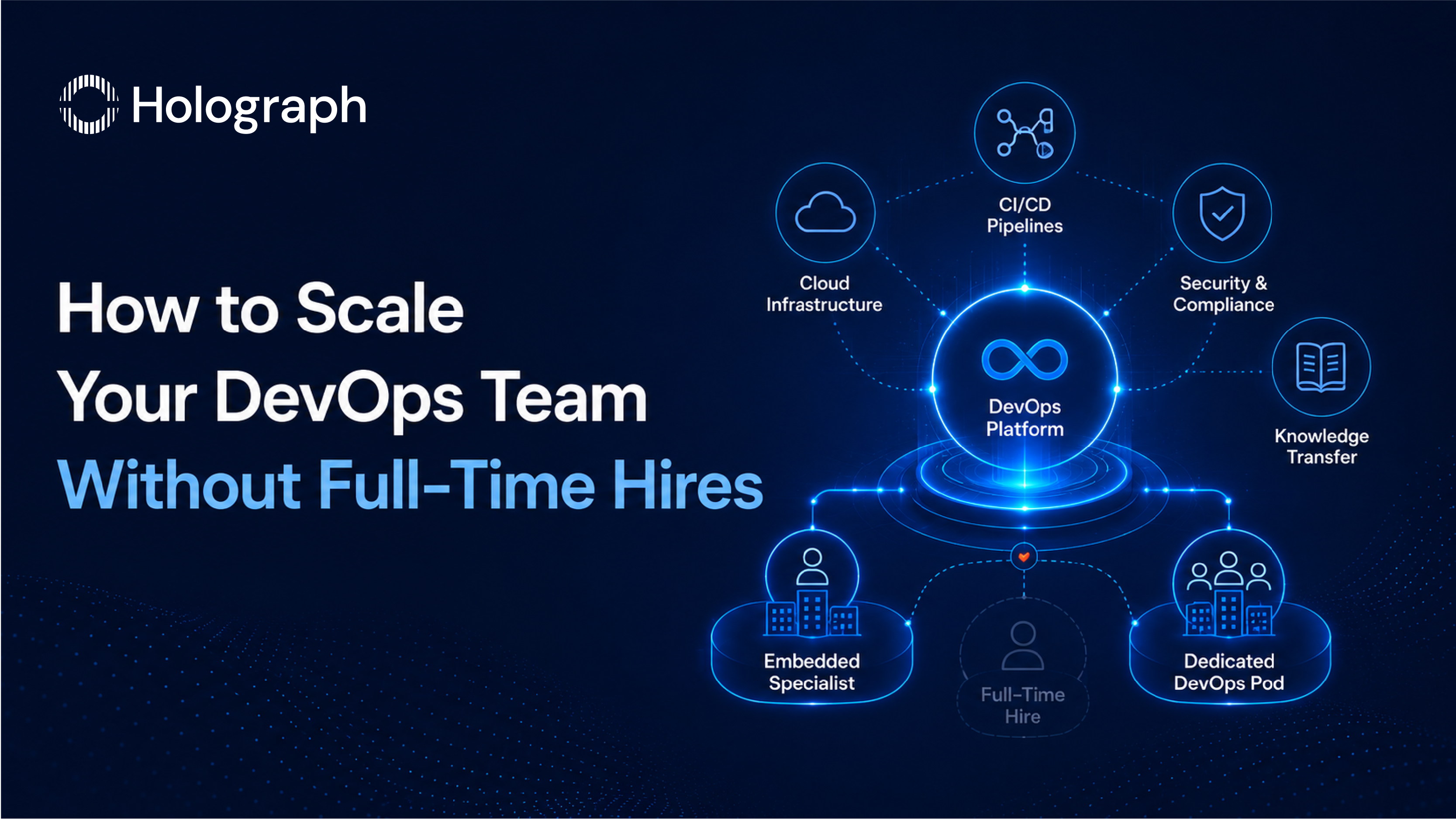
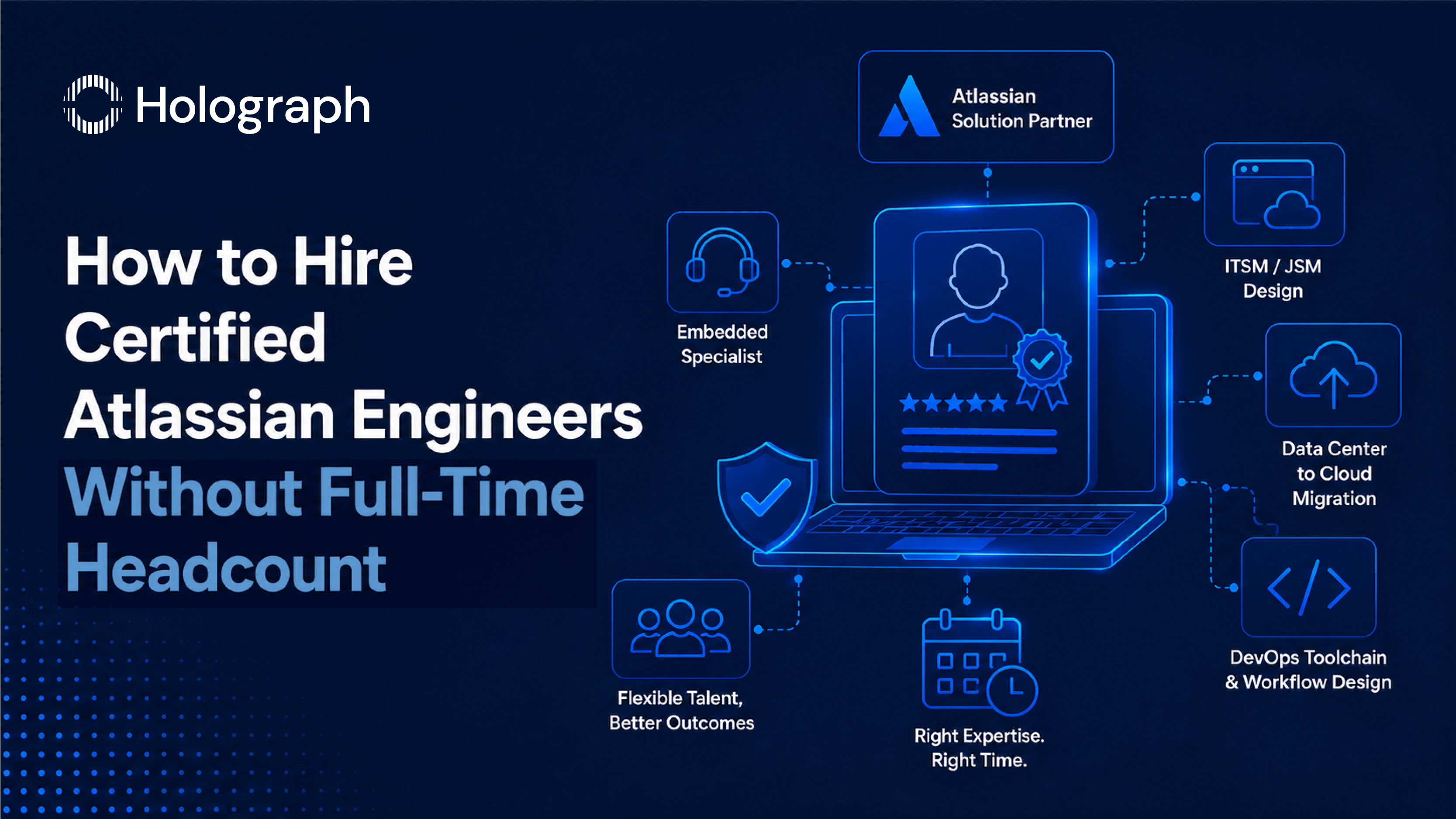
Holograph holds Atlassian Solution Partner status with certified specialisations in ITSM, Cloud, and DevOps, and AWS Advanced Tier Services Partner status. Delivery operates from a Global Capability Center across the USA, KSA, UAE, and India. For enterprises evaluating Atlassian-specific augmentation needs, the hiring and evaluation criteria for certified Atlassian engineers is covered in How to Hire Certified Atlassian Engineers Without Full-Time Headcount. For DevOps team scaling, see How to Scale Your DevOps Team Without Full-Time Hires.
The Decision Is About Ownership, Not Cost
The choice between staff augmentation and outsourcing is not primarily a cost decision. It is an ownership decision. Functions that require the client's context to perform correctly, that surface unexpected decisions mid-engagement, and that build institutional knowledge worth retaining suit augmentation. Functions that can be fully specified, contracted, and performed without ongoing client direction suit outsourcing.
For most enterprise platform work (ITSM implementation, cloud architecture, DevOps configuration), the ownership, contextual dependency, and knowledge retention considerations point to augmentation. For commoditised, repeatable, outcome-contractable functions, outsourcing remains a rational choice.
Getting the model wrong at the scoping stage is the expensive mistake. The framework in this post runs in 30 minutes. The contract it informs will run for months or years.
Holograph provides certified engineers and solution architects as embedded specialists and dedicated pods across Atlassian, AWS, Google Cloud, and Azure. See staff augmentation services.
Frequently Asked Questions
What is the difference between IT staff augmentation and IT outsourcing?
In staff augmentation, the client's internal IT team retains ownership of the function and its outcomes. External specialists deliver within the client's governance and direction. In outsourcing, operational responsibility for the function transfers to the provider, who delivers against a contract. The client retains the business outcome but loses day-to-day control over how the function operates. The structural difference is ownership of process, not just ownership of result.
When is IT outsourcing better than staff augmentation?
Outsourcing is the better choice when the function is commoditised, the outcome is measurable and contractable before work begins, and the work does not require the provider to develop ongoing contextual knowledge of the client's specific systems. Tier-1 helpdesk operations, basic infrastructure monitoring, and commodity network management are standard outsourcing candidates. Functions that require close integration with the client's architecture and decision history are not.
How do you decide between staff augmentation and outsourcing for an IT project?
Five questions determine the right model. Does the work require daily decisions that reflect your specific architecture and business context? Can the outcome be fully specified in a contract before the work starts? Do you need to reprioritise week-by-week? Does the work need to build internal capability? Do you want the institutional knowledge of this function to remain with your team? Functions where the answer to questions 1, 3, 4, and 5 is yes suit augmentation.
What are the risks of outsourcing complex IT platform work?
Complex platform work (ITSM design, cloud architecture, DevOps pipeline configuration) requires deep contextual knowledge of the client's environment. Outsourcing this work transfers operational control to a provider who cannot accumulate that context the way an embedded specialist can. Decisions made without client context produce configurations that reflect a generic enterprise, not the client's specific requirements. Scope changes are slow and expensive to implement through a contract boundary.
Does IT outsourcing build internal capability?
Outsourcing does not typically build internal capability. The institutional knowledge of the function accumulates with the provider over the life of the contract. When the contract ends, that knowledge leaves. Augmentation, structured with knowledge transfer as a scoped deliverable, builds internal capability. The specialists document decisions, train internal engineers, and prepare the team to manage what was built after the engagement concludes.
Can staff augmentation and outsourcing be used together?
The two models serve different function types and can operate in parallel within the same enterprise IT environment. A financial services firm might outsource tier-1 helpdesk operations while augmenting the team managing Atlassian ITSM configuration and DevOps pipelines. The decision for each function is made independently, based on the ownership, contextual dependency, and knowledge retention considerations that apply to that function specifically.
Not sure which model fits your work?