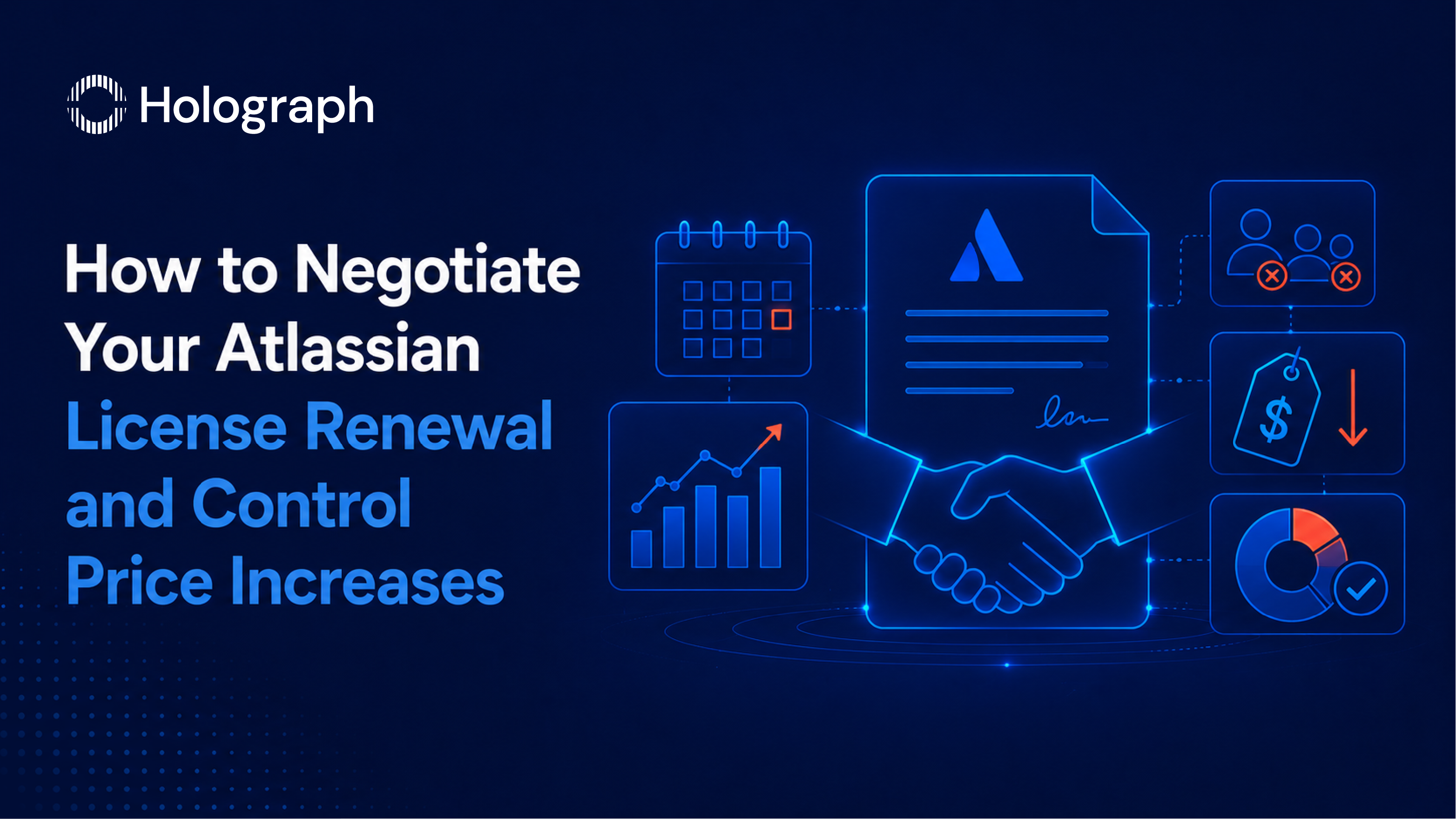
How to Negotiate Your Atlassian License Renewal and Control Price Increases
A payments company cut its Atlassian spend from $350,000 to $260,000, a $90,000 (25.7%) reduction, and avoided a 20% price increase by renewing on time after a licensing review. The saving did not come from a discount request. It came from arriving at the renewal with a clean user count and a plan, instead of accepting an automatic renewal at the new list price.
That is the difference a prepared renewal makes. Atlassian raises Cloud list prices periodically, and renewals process automatically unless you plan them. The moves below put the renewal on your calendar and your numbers.
Start early
A renewal is not a date, it is a project that ends on that date. The work starts months ahead. The default for a Cloud subscription is automatic renewal on a short notice window, so a renewal nobody is watching processes itself at the current list price, increases included. Diary the renewal well before the notice window opens, and treat that date as the deadline for the cleanup, not the moment you start it. The closer you get without preparation, the less room you have to change anything.
Audit active users before the quote
Right-sizing comes before pricing. Pull the active-user picture per product from the admin console and compare it against the licensed seat count, using the Last Seen data to find dormant accounts. Deactivate or suspend the users who no longer need access, and check for accounts still provisioned from a synced identity directory for people who have left, since those stay billable until they are removed from the directory.
This matters more at renewal than at any other time. On annual plans the user tier is fixed for the term once you commit, and cannot be changed until the next renewal. Committing to a clean count locks in a lower tier for the whole year; committing to an inflated one locks in the waste. Because crossing a tier band reprices the whole population, clearing enough inactive seats to drop under a boundary lowers the per-user rate across the estate, not just for the seats you removed. The seat discipline behind this is the same as in our guides to reducing Jira licensing costs and cutting Confluence licensing costs. Run both before the renewal, not after.
Choose annual after cleanup
Annual billing carries a lower effective rate than monthly for a stable estate, and it is the cleaner commercial model once your numbers are settled. But the sequence matters. Switch to annual after the user cleanup, not before, because annual tiers cannot be altered mid-term. If you lock in an annual tier while inactive users are still on the books, or while a team is about to be restructured, you pay for that inflated count all year. Estimate your realistic seat count for the next twelve months, then choose the tier that fits it. For a team whose headcount is genuinely uncertain, monthly buys flexibility until the picture is clear, and you move to annual once it is.
Right-size the edition and product mix at renewal
The renewal is also the moment to confirm each product is on the right edition. Teams drift onto higher tiers for features they no longer use, and the renewal is when you can move them back down without penalty. Review Premium and Enterprise placements against actual feature use, product by product, and align the mix to what teams need for the year ahead. Jira Service Management deserves a specific look here, because it bills per agent: confirm you are licensing the people who actually work tickets, not every employee given visibility, before the agent count is locked for the year. Bring Marketplace apps into the same review too, since app spend renews on its own cycles and is rarely benchmarked against real usage.
Bring the whole estate to one renewal date
When Jira, Confluence, Jira Service Management, and their apps renew on different dates, the negotiation happens in pieces, and the account never carries its full weight in one place. Aligning the product end dates, so the whole estate renews together, turns several small conversations into one, with the full picture and the full account in view at once. It also means the cleanup work happens once a year rather than being repeated for each product, and it closes the gaps where an app quietly auto-renews between the larger conversations.
When a licensing partner leads the renewal
A renewal done well takes time, telemetry, and a clear view of the estate. As an Atlassian Solution Partner, we run this for enterprise clients: we pull the usage picture, right-size the seats and editions, align the renewal dates, and time the commitment so the cleaned-up numbers are what gets signed. For the full estate view, start with our enterprise guide to reducing Atlassian licensing costs.
Frequently asked questions
When should I start an Atlassian renewal?
Months before the renewal date, ahead of the notice window. Early preparation leaves time to right-size users and editions before a quote is built. A last-minute renewal defaults to the current list price, increases included.
Is annual or monthly Atlassian billing cheaper?
Annual billing carries a lower effective rate than monthly for a stable estate. The catch is that annual tiers are fixed for the term, so clean up your user count first and commit to a tier that fits real demand.
How do we avoid an automatic price increase at renewal?
Plan the renewal instead of letting it auto-process. Right-size the estate so the cleaned-up numbers are what you commit to, and confirm the terms before the renewal date rather than accepting the default quote.
Can we reduce our user count at renewal?
Yes. Inside an annual term the tier is fixed, but the renewal is the point where you can drop users, change tiers, and rebundle the product mix. That is why the pre-renewal cleanup is the single most valuable step in the whole cycle.
Book a free assessment before your next renewal